 Technology
United Arab Emirates Launches Mars Mission
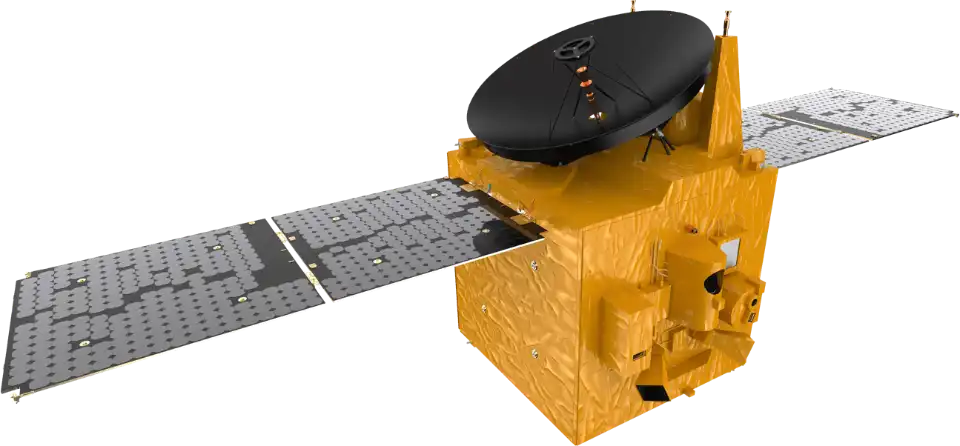
United Arab Emirates Launches Mars MissionNFK Editors - July 20, 2020The United Arab Emirates (UAE) has launched the first mission to Mars by an Arab country. After several delays caused by bad weather, the probe, named “Hope”, was successfully launched early Monday morning.Shortly before 7 am (in Japan), a Japanese rocket carrying the UAE probe blasted off from Tanegashima Space Center in southern Japan. The rocket remained on course after its first booster stage separated. Booster rockets push the main spacecraft up, falling back to earth when their fuel is gone.Embed from Getty ImagesThe United Arab Emirates has launched the first mission to Mars by an Arab country. After several delays caused by bad weather, the probe, named “Hope”, was successfully launched early Monday morning.The probe is expected to reach the Red Planet in February, 2021. For the next two years, it will orbit Mars. The probe has several devices which will allow it to study the planet’s upper atmosphere. The UAE says Hope will be the first mission to provide details about Mars’s atmosphere through all Martian seasons.The probe is expected to reach the Red Planet in February, 2021. For the next two years, it will orbit Mars. The probe has several devices which will allow it to study the planet’s upper atmosphere.(Source: Emirates Mars Mission.)Monday’s launch was one of three Mars missions scheduled during the next couple of weeks. China plans to launch a complicated mission named Tianwen-1 on July 23. The US space agency NASA is scheduled to launch a new Mars rover named Perseverance on July 30.All of these trips are starting at roughly the same time because right now is the best time to travel between Earth and Mars, using as little fuel as possible. Another chance like this won’t come for more than two years.The launch of the Hope probe – known as “Al-Amal” in Arabic – is a huge step for a small country like the UAE. The UAE only became independent of the United Kingdom in 1971 – less than 50 years ago. The Hope probe is shown above.(Source: Mohammed bin Rashid Space Centre.)The launch of the Hope probe – known as “Al-Amal” in Arabic – is a huge step for a small country like the UAE. The UAE only became independent of the United Kingdom in 1971 – less than 50 years ago.The country’s space agency was started in 2014. Before that, the UAE had only launched a few satellites. In September of last year, the country sent its first astronaut to the International Space Station.Embed from Getty ImagesThe UAE’s space agency was only started in 2014. Above, team members at the Mohammed Bin Rashid Space Center in Dubai prepare for the launch.One of the goals of the Hope mission is to inspire younger Arabs, especially those in the UAE. The country grew rich off of oil and gas, but it’s now looking for other ways of bringing money into the country that will be more secure in the future.That’s one reason it’s encouraging young people to focus on science and technology. The efforts seem to be working. Most of the scientists and engineers who worked on the Mars mission are under 35.Most of the scientists and engineers who worked on the Mars mission are under 35. Women make up around 34% of all of the Hope mission’s workers, and 80% of its science team.(Source: Emirates Mars Mission.)The UAE’s Hope mission is striking in another way, too. While just 28% of workers in the UAE are female, women are playing a large role in the UAE’s science program. Women make up around 34% of all of the Hope mission’s workers, and 80% of its science team.Sarah al-Amiri is a 33-year-old woman who leads the science for the Hope mission. She is also the country’s Minister of State for Advanced Sciences and heads the country’s Science Council.Sarah al-Amiri (above) is a 33-year-old woman who leads the science for the Hope mission. She is also the country’s Minister of State for Advanced Sciences and heads the country’s Science Council.(Source: Sikarin Fon Thanachaiary – Foundations World Economic Forum [CC BY], via Wikimedia Commons.)A US space expert who worked with the UAE team says it’s “incredible” that the country has gone from launching satellites to a Mars mission in just six years.“It’s not about reaching Mars,” says Omran Sharaf, the manager of the Hope mission. “For the Emirates, it’s more about the journey.”Did You Know…?The UAE has big plans beyond their current mission. By 2117, the country hopes to have developed a settlement for people to live on Mars.Check Yourself0/41. On Monday, the UAE became the first Arab country to launch a mission to Mars.True False2. Several Mars missions are launching now because it's the best time to travel between Earth and Mars, using as little _______________ as possible3. What year did the UAE start its space agency?4. How much of the Hope mission's science team is female?28%16%50%80%Omran Sharaf said the Hope mission wasn't about reaching Mars, but was "about the journey." What do you think he meant by that?ResetSourceswww.nytimes.comwww.scmp.comwww.dw.comwww.space.comwww.cnet.comwww.dw.comwww.nature.comwww.nytimes.comwww.smithsonianmag.comShare:This week marks 25 years of humans living in space. On November 2, 2000, three astronauts became the first full-time workers at the International Space Station. Since then, the ISS has never been empty.Meteorite That Hit House Is Older Than EarthNFK Editors - Aug 14, 2025When a fireball fell through the sky in the southeastern United States on June 26, it caught the attention of people across seven states. It was a meteor breaking up as it fell through the Earth’s atmosphere. A small part of the space rock tore through a house in Georgia. Scientists now say the meteorite is older than the Earth.Blue Origin Sends Six Women Into SpaceNFK Editors - Apr 16, 2025On Monday, the aerospace company Blue Origin launched its spacecraft RSS Kármán Line on a ten minute trip into space. The spaceship carried the first all-female crew to go into space since Russian astronaut Valentina Tereshkova’s solo mission in 1963.Private Company Makes Perfect Moon LandingNFK Editors - Mar 5, 2025On Sunday, a company called Firefly Aerospace became the first private company to make a perfect landing on the moon. Firefly is working with NASA, and its spacecraft, Blue Ghost, is carrying out several experiments for the space agency.
 Technology
News Roundup: Dust Storm, Fake Pilots, NASA Renames Headquarters
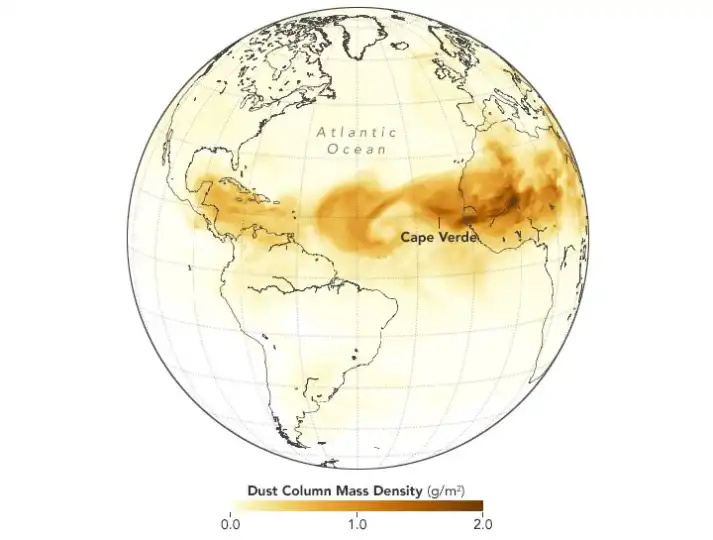
News Roundup: Dust Storm, Fake Pilots, NASA Renames HeadquartersNFK Editors - June 28, 2020Sahara Dust Cloud Blows Across CaribbeanEvery year, a large cloud of dust rises from the Sahara Desert and crosses the Atlantic Ocean before arriving in the Caribbean. The pattern is called the Saharan Air Layer. It’s part of a natural cycle that helps develop farmland and beaches in Central and South America.This year’s Saharan Air Layer is the largest in at least 50 years. The cloud covers an area as large as the United States and ranges between 1 mile (1.5 kilometers) and 3.7 miles (6 kilometers) in thickness.Every year, a large cloud of dust rises from the Sahara Desert and crosses the Atlantic Ocean before arriving in the Caribbean. The pattern is called the Saharan Air Layer. The map above shows dust crossing the Atlantic on June 28, 2018.(Source: NASA EarthObservatory.)The dust cloud has blanketed much of the Caribbean and Mexico in a thick haze, raising temperatures and lowering visibility. The dust cloud is also bringing dangerous levels of pollution.Puerto Rico has been hit hard by the cloud. At one point its air quality was rated at 305 – almost twice as high as its previous record of 154. Air quality ratings above 150 are considered “Unhealthy”. Over 300, they’re considered “Hazardous” (dangerous).Embed from Getty ImagesThe dust cloud has blanketed much of the Caribbean and Mexico in a thick haze, raising temperatures and lowering visibility. The dust cloud is also bringing dangerous levels of pollution. Above, Puerto Rico on June 22.Over the weekend, the dust cloud hit the southeastern United States, covering states like Florida, Georgia, Alabama, Mississippi, and Texas.Though the dust cloud will slowly break up over time, a second cloud may be forming behind it.There are two advantages to the dust cloud. The first is that it makes thunderstorms and hurricanes less likely to form. The second is that since red and orange light have an easier time getting through the cloud, the dust can make sunrises and sunsets especially beautiful.Pakistan Discovers 30% of Pilots Have Fake LicensesThe Pakistani Civil Aviation Authority (CAA), which is in charge of airlines and flying in Pakistan, reported last week that around 30% of the country’s pilots had fake flying licenses. The result is part of an investigation that started back in February, 2019.The CAA says the country has about 860 active pilots, and as many as 262 of them may be flying with fake licenses.The Pakistani Civil Aviation Authority reported last week that around 30% of the country’s pilots had fake flying licenses. As a result, Pakistan International Airlines has told 150 of its pilots that they’re no longer allowed to fly.(Source: Aleem Yousaf [CC BY-SA], via Wikimedia Commons.)The news has caused Pakistan International Airlines (PIA) to take a close look at its 434 pilots. As a result, PIA has told 150 of its pilots that they’re no longer allowed to fly.There is a strong focus on the skills of pilots in Pakistan now, following a crash last month that killed 98 people. The crash was judged to be the result of pilot error.NASA Renames Headquarters After Mary JacksonNASA has renamed its headquarters in Washington, DC for Mary Jackson. Ms. Jackson was a math expert who became NASA’s first black female engineer in 1958. At that time, few black people and few women were given jobs with such a high level of responsibility.NASA renamed its headquarters in Washington, DC for Mary Jackson. Ms. Jackson was a math expert who became NASA’s first black female engineer in 1958. Above, Ms. Jackson stands in front of a NASA computing machine in 1977.(Source: NASA [Public domain], via Wikimedia Commons.)A book (and movie) called “Hidden Figures” told the story of Ms. Jackson and two other highly talented black women who worked for NASA in the early days. The name “hidden figures” refers to the fact that though the women were an important part of NASA’s efforts to put a person on the moon, they weren’t given much credit for their work.Now NASA is trying to make sure the women are remembered. Last year, the street in front of NASA’s headquarters was renamed “Hidden Figures Way.”Sourceswww.npr.orgwww.laht.comwww.voanews.comedition.cnn.comwww.scmp.comwww.voanews.comwww.laht.comwww.npr.orgwww.smithsonianmag.comShare:
 Technology
Using Drones to Deliver Summer Reading
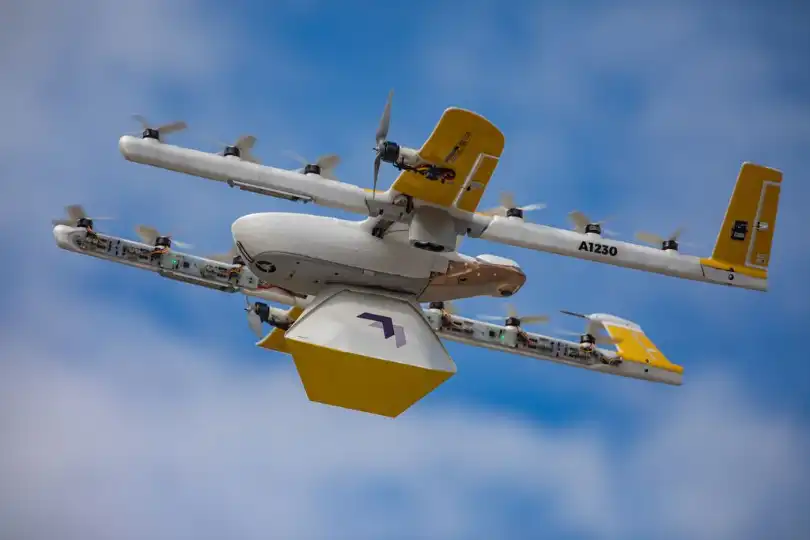
Using Drones to Deliver Summer ReadingNFK Editors - June 25, 2020Christiansburg, Virginia —(Map)Students in Christiansburg, Virginia have an unusual option for getting books this summer – having them delivered by drone. The Montgomery County School District is teaming up with a company called Wing to deliver summer reading by drone.The program was the idea of Kelly Passek, who runs the library at Blacksburg Middle School. When schools closed because of the coronaviruspandemic, Ms. Passek and other librarians worked hard to make sure students could still get books, delivering them on school buses.The Montgomery County School District in Christiansburg, Virginia is teaming up with a company called Wing to deliver summer reading to students by drone. The program was the idea of Kelly Passek, who runs the library at Blacksburg Middle School (above).(Source: Idawriter [CC BY-SA], via Wikimedia Commons.)But with the school year over and public libraries closed, Ms. Passek didn’t like the idea of kids going all summer without books. She realized that drones might be a solution.Drones are small aircraft that can be flown and controlled by someone on the ground. Around the world, many companies are exploring using drones to deliver items, especially to areas that are hard to reach.Drones are small aircraft that can be flown and controlled by someone on the ground. Many companies are beginning to use drones to deliver items, especially to areas that are hard to reach. Above, one of the drones run by a company called Wing.(Source: Wing.)The coronavirus, which has required people to stay at home and keep safe distances apart, has made drone delivery even more important.Wing is a drone delivery company that is owned by Alphabet, the same company that owns Google. Though Wing has been working on drone delivery for years, it has only recently begun to run real trials of its program. Last year, Wing began making deliveries in Canberra, Australia. It’s also made drone deliveries in Helsinki, Finland.Wing’s drones can fly nearly 70 miles (113 kilometers) per hour and can go about 12 miles (19 kilometers) in one round trip. The drones weigh only 10.6 pounds (4.8 kilograms), and can carry up to three pounds (1.4 kilograms).Wing has been working on drone delivery for years, but it has only recently begun to run real trials of its program. Last year, Wing began making deliveries in Canberra, Australia (above). It’s also made drone deliveries in Helsinki, Finland.(Source: Wing.)Wing says that using a drone for deliveries pollutes less than driving a car for the same tasks.Last October, Wing began offering delivery services in a 4-mile (6.5-kilometer) area around Christiansburg, Virginia. That’s what gave Ms. Passek the idea. She got support from the school district and then talked to Wing about her idea. The company quickly agreed.Starting June 11, Ms. Passek began sending out books using drones.Now Wing is delivering books to students in Virginia. Ms. Passek gets the books from different libraries in the school district. Then she puts them in special packages like the one above, and brings them to Wing.(Source: Wing.)Here’s how it works: Students can put in book requests over the internet. Ms. Passek goes to get the books from different libraries in the district. Then she puts them in special packages and brings them to Wing. Wing then flies the books to students, lowering the books to the ground with a cable.The program is open to any of the district’s students who live in Wing’s delivery area – about 600 kids in all. Students won’t return the books by drone, though. They’ll keep them until the schools open back up.The program serves about 600 of the district’s students who live in Wing’s delivery area. “I think kids are going to be just thrilled to learn that they are going to be the first in the world to receive a library book by drone,” Ms. Passek said.(Source: Wing.)“I think kids are going to be just thrilled to learn that they are going to be the first in the world to receive a library book by drone,” Ms. Passek said.The only bad part? Kids can’t check out books that weigh more than three pounds!Check Yourself0/41. Students in Christiansburg, Virginia couldn't get books over the summer because the public _______________ are closed.2. How much weight can Wing's drones carry?5 pounds (2.3 kilograms)10 pounds (4.5 kilograms)3 pounds (1.4 kilograms)1 pound (.45 kilograms)3. Wing flies the books to the students, lowering the books to the ground with a _______________.4. When the kids are done with the books, they return them by drone.True FalseCan you think of other important services that could be handled well by drones?ResetSourceswww.washingtonpost.comwww.cnn.comwww.smithsonianmag.comwww.nytimes.comgizmodo.commedium.comChristiansburg, VirginiaView Larger MapShare:
 Technology
Forest Fires Put Out Near Chernobyl
Forest Fires Put Out Near ChernobylNFK Editors - April 15, 2020Pripyat, Ukraine —(Map)Ukraine reports that fire fighters have put out forest fires near the location of the world’s worst nuclear accident. The forest fires threatened to spread dangerous radiation through the air, though the accident happened over 30 years ago.Nuclear power is created by splitting atoms. It’s a dangerous process – built on the science behind nuclear weapons. Nuclear power produces toxic waste which must be handled and stored with great care.The great danger of nuclear power is radiation. If something is “radioactive” that means it gives off radiation. Radiation is energy traveling in waves.The great danger of nuclear power is radiation. If something is “radioactive” that means it gives off radiation. Radiation is energy traveling in waves. The warning symbol for radiation can be seen in the yellow triangle on this sign for the Chernobyl Exclusion Zone.(Source: Adam Jones [CC BY-SA], via Wikimedia Commons.)High levels of radiation can cause sickness or even death. It can also affect the DNA of humans and animals. That means it can affect the children of people who have been exposed to high levels of radiation.The Chernobyl Nuclear Power Plant (CNPP) is about 60 miles (100 kilometers) away from Kyiv, Ukraine. In 1986, Ukraine was part of the Soviet Union (USSR) – a huge country that included Russia and many other nations. The USSR broke up in 1991 and most of those smaller nations, like Ukraine, are now their own countries.In 1986, the Chernobyl Nuclear Power Plant (shown above, in 2007) had the worst nuclear accident in history. A series of mistakes and accidents caused an explosion and a huge fire, which released radioactive pollution across much of Europe.(Source: IAEA Imagebank [CC BY-SA], via Wikimedia Commons.)In 1986, the CNPP had the worst nuclear accident in history. A series of mistakes and accidents caused an explosion and a huge fire, which burned for nine days. During that time, radioactive pollution was released over parts of the USSR and western Europe.As a result of the disaster, entire cities had to be cleared. Over 100,000 people had to leave their homes forever. A 1,000 square mile (2,600 square kilometer) area around the CNPP was set apart as the “Chernobyl Exclusion Zone” to keep people away from the radioactive pollution.As a result of the disaster, entire cities had to be cleared. Over 100,000 people had to leave their homes forever. A huge area around the CNPP was set apart as the “Chernobyl Exclusion Zone” to keep people away from the radioactive pollution (above).(Source: Jorge Franganillo [CC BY], via Wikimedia Commons.)Much of the land in the Zone is forest and grassland. Radioactivity breaks down slowly over time, so the radiation has dropped some by now. The radioactive pollution has become part of the plants and the dirt in the area.But on April 4, a fire broke out in the Zone. The danger from fires there is much greater than regular forest fires because they can release the radioactive pollution back into the air. Once the pollution is in the air, it can be spread by the wind.Forest fires are common in the area, where many trees were killed by the radiation, but the recent fires were larger than normal.Much of the land in the Zone is forest and grassland. The danger from fires there is much greater than regular forest fires because they can release the radioactive pollution back into the air. Once the pollution is in the air, it can be spread by the wind.(Source: ArticCynda [CC BY-SA], via Wikimedia Commons.)Over the last 10 days, hundreds of fire fighters have been struggling against the blazes. One fire came close to the CNPP. Keeping fires away from the plant is important, since dangerous toxic material is still stored there.Fighting the fire was much more challenging than normal, because of the radiation dangers. In some places, fire fighters couldn’t dig ditches to stop the fire from spreading, so most of their efforts went into dropping water from the air.Fighting the fire was much more challenging than normal, because of the radiation dangers. Most of the efforts went into dropping water from the air. Ukraine’s government says there are no major open fires still burning.(Source: State agency of Ukraine on Exclusion Zone management [CC BY], via Wikimedia Commons.)Rain in the area helped bring the fires under control. Ukraine’s government says that there are still some small grass fires, but there are no major open fires still burning. The government says radiation levels in the air in Kyiv and nearby areas are normal.Did You Know…?The CNPP had four reactors and only one had an accident. The other three continued to run until 2000. Now the site is being cleaned up – a process that will take until 2065. Still, scientists don’t expect people to be able to live in the area for about 20,000 years.Check Yourself0/41. Nuclear energy creates _______________ waste which must be handled and stored very carefully.2. In 1986 the Chernobyl Nuclear Power Plant had an explosion followed by a fire which spread radioactive pollution across much of Europe. How long did the fire burn?nine daysthree weeksnine hourstwo days3. The "Chernobyl Exclusion Zone" is a huge area which is off limits in order to keep people away from the radioactive pollution.True False4. Hundreds of fire fighters worked for days to put the forest fires out. What finally helped get the fires under control?Many people believe nuclear energy will be important for fighting the climate crisis. When it works correctly, it pollutes far less than coal or oil. Do you think it's worth the risk? Why or why not?ResetSourceswww.dw.comwww.president.gov.uawww.theguardian.comwww.nytimes.comwww.theguardian.comwww.dw.comwww.bbc.comwww.abc.net.auen.wikipedia.orgPripyat, UkraineView Larger MapShare:A town in Finland has begun using the world’s largest “sand battery” to help provide heat. The unusual method of storing energy allows the town to create heat when electricity prices are cheap, and store it for long periods of time. The heat can then be used whenever it’s needed.Trump Stops Wind Project That’s 80% CompleteNFK Editors - Aug 27, 2025A huge offshore wind farm project near Rhode Island has been suddenly stopped by the US government. The project, which is 80% completed, was meant to bring clean energy to hundreds of thousands of homes. Some people worry that the government is making it too hard for wind power projects to succeed.Europe Struggles With Heat Waves, WildfiresNFK Editors - Aug 19, 2025Heat waves across Europe are bringing record temperatures and dangerous, widespread wildfires. Southern European countries like Spain, Greece, and Portugal are being hit especially hard. But summer heat waves have also caused problems in Northern Europe and elsewhere around the globe.Earth Day 2025 Focuses on PowerNFK Editors - Apr 23, 2025Yesterday was the 55th celebration of Earth Day. This year’s theme was “Our Power, Our Planet”, with a focus on how rapidly growing renewable energy sources are promising hope in the fight against the climate crisis.
 Technology
Proteus: a Plan for an Undersea Research Station
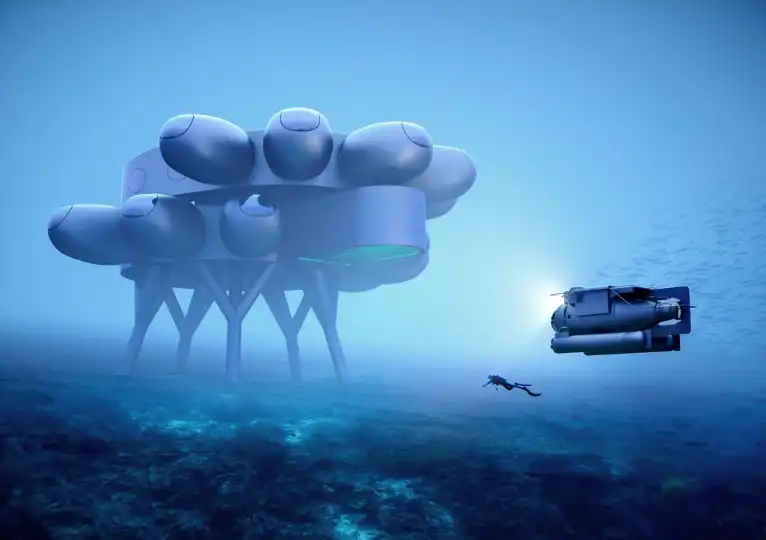
Proteus: a Plan for an Undersea Research StationNFK Editors - August 11, 2020Curaçao —(Map)Fabien Cousteau, a well-known ocean explorer, has announced plans to build a large research station under the ocean. The goal of the project is to become an “underwater version of the International Space Station” (ISS).Fabien Cousteau, a well-known ocean explorer, has announced plans to build a large research station under the ocean. The design is shown above. The goal of the project is to become an “underwater version of the International Space Station”.(Source: Fabien Cousteau’s PROTEUS™. Concept designs by Yves Béhar & fuseproject.)Mr. Cousteau is the grandson of Jacques Cousteau, an ocean scientist who brought the wonders of the sea to the attention of people around the world. Jacques Cousteau helped invent the Aqua-Lung, an early version of the scuba breathing gear now used by divers everywhere.Fabien Cousteau has followed a similar path, exploring the sea as a scientist and working to protect the oceans.Fabien Cousteau (above) is the grandson of Jacques Cousteau, an ocean scientist who brought the wonders of the sea to the attention of people around the world. Fabien Cousteau has continued his grandfather’s work of promoting and protecting the oceans.(Source: FCousteauFan [CC BY-SA], via Wikimedia Commons.)Though oceans cover more than 70% of our planet, they still aren’t well explored. NOAA (National Oceanic and Atmospheric Administration) says we have created maps of less than 20% of the world’s oceans, and only 5% have been explored.Space seems to have gotten much more attention, even though it’s farther away. The ISS has been around for more than 20 years, and more people have gone to the moon than have gone to the deepest point in the ocean.Though oceans cover more than 70% of our planet, they still aren’t well explored. NOAA says we have created maps of less than 20% of the world’s oceans, and only 5% have been explored.(Source: WikimediaCommons.org.)Mr. Cousteau believes exploring the ocean is far more important than exploring space. “It’s our life support system. It is the very reason why we exist in the first place,” he says.But though the ocean is all around us, studying it is a challenge. Divers are limited in how far down they can go and how long they can stay below. Returning to the surface can be dangerous. After a deep dive, divers must wait for hours before they dive again. All of this means that undersea experiments are very limited.The new undersea laboratory is designed to solve many of the problems involved in doing ocean research from the surface. Named “Proteus”, the lab is a 4000-square-foot (370-square-meter) structure that can be a home for up to 12 people at a time.(Source: Fabien Cousteau’s PROTEUS™. Concept designs by Yves Béhar & fuseproject.)The new undersea laboratory is designed to solve many of those problems. Named “Proteus”, the lab is a 4000-square-foot (370-square-meter) structure that can be a home for up to 12 people at a time.By actually living beneath the sea, scientists will be able to dive and work for much longer without worrying about the dangers of coming to the surface.Mr. Cousteau says that the research base won’t just be used to study and help protect the sea, but also to research new ways of creating energy, growing food, and perhaps even searching for new medicines.(Source: Fabien Cousteau’s PROTEUS™. Concept designs by Yves Béhar & fuseproject.)Mr. Cousteau says that the research base won’t just be used to study and help protect the sea, but also to research new ways of creating energy, growing food, and perhaps even searching for new medicines.The power for the station is expected to come from solar energy and the movement of the ocean. Proteus is also expected to have the first underwater greenhouse in the world, so that the lab will be able to grow some of its own food.Like the ISS, Proteus is designed so that it can grow in the future, as scientists decide to add new sections or equipment to the station.Like the ISS, Proteus is designed so that it can grow in the future, as scientists decide to add new sections or equipment to the station.(Source: Fabien Cousteau’s PROTEUS™. Concept designs by Yves Béhar & fuseproject.)Proteus was designed by Yves Behar, a well-known designer. Together Mr. Cousteau and Mr. Behar are working to raise money to build Proteus. They say it will cost about $135 million.Plans call for Proteus to be built on the sea floor 60 feet (18 meters) below the ocean’s surface off the island of Curaçao in the Caribbean ocean. Mr. Cousteau hopes to have the lab completed and ready to use by 2023.Did You Know…?Proteus isn’t the first underwater laboratory. Since 1986, there has been a small laboratory called Aquarius off the coast of Florida. Mr. Cousteau set a record for living underwater when he worked in Aquarius for 31 days in 2014. The Proteus lab will be 10 times as large as Aquarius.Since 1986, there has been a small laboratory called Aquarius (above) off the coast of Florida. Mr. Cousteau set a record for living underwater when he worked in Aquarius for 31 days in 2014. The Proteus will be 10 times as large as Aquarius.(Source: NOAA [Public domain], via Wikimedia Commons .)Check Yourself0/41. Doing ocean research from the surface is a challenge because diving time is so limited.True False2. How much of the world's oceans have been explored?20%80%50%5%3. Proteus will have the world's first underwater _______________ and help explore new ways of growing food.4. How much is Proteus expected to cost?$35 million$150 million$135 million$1.35 millionDo you agree with Mr. Cousteau that it's important to explore the sea? Why do you think exploring space has gotten so much more interest?ResetSourceswww.cnn.comwww.fastcompany.comwww.cnet.comnewatlas.comwww.forbes.comen.wikipedia.orgCuraçaoView Larger MapShare:A group called Oceanix has come up with a plan to create the world’s first floating city. In early April their plan was discussed at the United Nations.You might be interested in…Are Orcas and Dolphins Working Together?NFK Editors - Dec 17, 2025Scientists have discovered that two different kinds of sea animals – orcas and dolphins – may be working together to hunt for salmon. Orcas and dolphins are both clever, but it’s unusual for two different kinds of animals to cooperate in this way.Scientists Discover “Death-Ball” Sponge & Other New SpeciesNFK Editors - Nov 19, 2025By exploring deep under the Southern Ocean, researchers have discovered 30 unusual species that are new to science. The species include a sponge that eats animals, worms that eat bones, and several news sea stars and sea worms.Pig Kidney Transplant Trial Begins in USNFK Editors - Nov 12, 2025Doctors at a hospital in New York have begun a program that will test whether specially designed pig kidneys can be used to replace human kidneys. The results of the trial program could help thousands of people who are waiting for a new kidney.Scientists Spot Unusual Hybrid “Grue Jay” in TexasNFK Editors - Sep 25, 2025Scientists have reported on an unusual “hybrid” bird spotted in Texas – a cross between a blue jay and a green jay. The discovery is surprising because the two species are quite different. Scientists think the hybrid could be a result of climate change.
 Technology
For Real? Storm Alphabets, Mailing Litter, & an Old TV
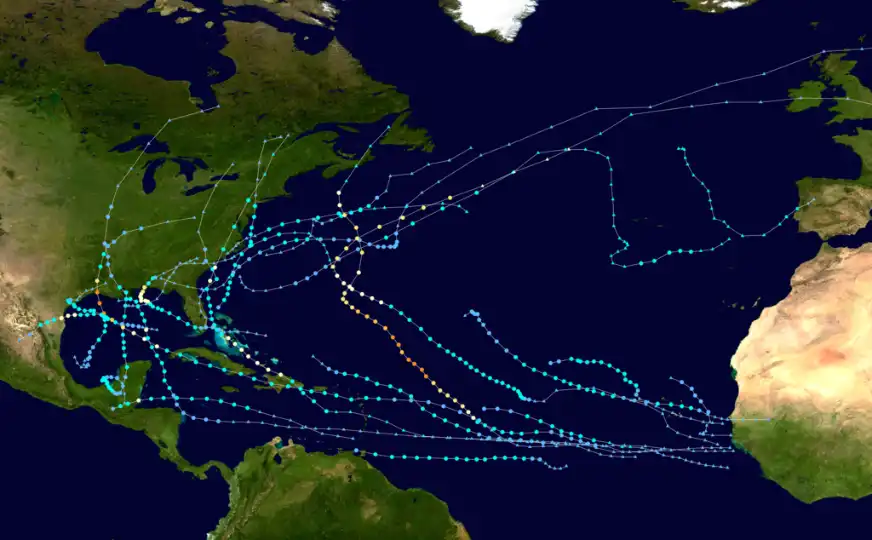
For Real? Storm Alphabets, Mailing Litter, & an Old TVNFK Editors - September 26, 2020Second Alphabet Needed to Name This Year’s HurricanesThis year’s busy hurricane season in the Atlantic Ocean has made it hard for the US National Hurricane Center (NHC) to name all of the large storms. For the second time ever, the NHC has had to use a second alphabet to come up with the names.Normally the NHC uses alphabetical lists of 21 storm names every year, skipping unusual letters like Q, U, X, Y, and Z. The lists repeat every six years.This year’s busy hurricane season in the Atlantic Ocean has made it hard for the US National Hurricane Center to name all of the large storms. The map above shows the tracks of the hurricanes in the 2020 Atlantic hurricane season.(Source: Master0Garfield Public domain, via Wikimedia Commons.)But this year, there have already been 23 named storms, forcing the NHC to begin giving storm names from the Greek alphabet (Alpha and Beta). This has only happened once before, in 2005, when there were 27 named storms.Officially, the Atlantic hurricane season runs from June 1 to November 30. But this year, the first storm, Arthur, formed on May 16.This year, there have already been 23 named storms, forcing the NHC to begin giving storm names from the Greek alphabet (Alpha and Beta). The National Weather Service posted the message below.With the naming of Subtropical Storm #Alpha, we've officially entered the Greek Alphabet for named Atlantic storms this year.We've made it as far as Zeta one time on record, in 2005.Visit https://t.co/meemB5uHAR for the latest. pic.twitter.com/B4TO7JL1Kv— National Weather Service (@NWS) September 18, 2020This hurricane season has already set a number of records, and there are still more than two months left. Many people are wondering (and worrying) about how many Greek letters will be needed before the season finally ends.Littering in Thailand? Expect a Package in the MailThailand has an unusual plan to get tourists to stop littering: mailing the litter back to the people who dropped it.Even though Thailand has laws against littering which can lead to heavy fines or even jail time, the country struggles to control the garbage created by tourists.Recently, in response to a trashy campsite in Thailand’s oldest national part, Khao Yai National Park, the country’s Environment Minister, Varawut Silpa-archa, announced that he’s mailing the litter back to the litterbugs – after posting pictures of it on social media.Thailand’s Environment Minister, Varawut Silpa-archa, announced that he’s mailing litter back to litterbugs – after posting pictures of it on social media. Above, the litter being packaged up with a note saying, “You forgot these things at Khao Yai National Park.”(Source: Thailand Ministry of Natural Resources and Environment via FaceBook.)“Your trash – we’ll send it back to you,” reads one post. The pictures show plastic bottles and chip bags packaged up with a friendly note saying, “You forgot these things at Khao Yai National Park.”The country seems to be hoping that returning the litter in a public way will embarrass the litterbugs, and remind other people not to litter in the first place.So how did they figure out who left the garbage? By checking the park’s records and studying the trash left behind.Internet Troubles for 18 Months. The Problem? An Old TV.For a year and a half, the small village of Aberhosan in Wales, United Kingdom struggled to understand why the internet suddenly stopped working every morning at 7.The local internet provider, Openreach, replaced lots of old cables in the town in the hopes of solving the problem. No luck.Finally, Openreach sent out a team at 6 in the morning to check for electrical problems. Sure enough, right at 7, they saw a big spike of electrical noise.The workers tracked the noise down to one house, where the owner had a very old TV which was turned on every morning at 7 a.m. The TV (not the one above) created enough electrical noise to take out the internet for the rest of the village.(Source: WikimediaCommons.org.)The workers were soon able to track the noise down to one house, where the owner had a very old TV. Like clockwork, every morning at 7 a.m., the owner turned on the TV, which created enough electrical noise to take out the internet for the rest of the village.The TV’s owner was very embarrassed to learn that their device was the source of the problem, and promised to never turn it on again.Sourceswww.npr.orgwww.smithsonianmag.comen.wikipedia.orgwww.nytimes.comwww.laht.comwww.bbc.comarstechnica.comwww.bbc.comwww.news.com.auShare:Strong storms and heavy rains have caused terrible flooding in several countries in southern Asia, including Indonesia, Sri Lanka, and Thailand. In all, over 1,100 people have died, and millions have been forced to leave their homes.Rare “New” Music by Bach Found and PerformedNFK Editors - Nov 27, 2025Last week, two “new” pieces of music by the famous composer Johann Sebastian Bach were played for the first time in centuries. The discovery of the pieces is the result of 30 years of hard work by Peter Wollny, who studies Bach’s music.Is Seeing Believing? AI Videos Look Extremely RealNFK Editors - Nov 5, 2025Over the last year or so, the quality of AI-generated videos has become so good that it’s extremely difficult to tell whether a video is real or not. An English TV channel recently ran a show about AI. At the end of the episode, the “woman” presenting the show announced that she wasn’t real.
 Technology
News Roundup: Coronavirus Hits Businesses & Tech for Traffic Jams – x 2
News Roundup: Coronavirus Hits Businesses & Tech for Traffic Jams – x 2NFK Editors - February 8, 2020Coronavirus Spreads, Causing Human and Business WorriesThe new coronavirus, which first appeared in Wuhan, China in December, has continued to spread. Currently there are nearly 35,000 cases, and 720 people have died. Though the disease has spread to over 25 other countries, almost all the cases are in China.In response to the outbreak, the Chinese government closed off 50 million people in Wuhan and cities near it. As the virus spread to other areas of China, the government took more actions to limit the spread of the disease.Currently, most people around the country are staying home. If people go out, they wear masks. Many places where people gather have been closed, including many museums, theaters, restaurants, and shopping areas.Currently, most people around the country are staying home. If people go out, they wear masks. Many places like museums, theaters, restaurants, and shopping areas have been closed. This Beijing street is normally busy, but in late January, it was empty.(Source: Pau Colominas [CC BY-SA], via Wikimedia Commons.)Hundreds of companies have closed their factories until the disease is more under control. Since China makes so many parts for products used by companies around the world, the effects of the factories shutting down are being felt in other countries, too.Car companies like Honda, Toyota, and others have closed their factories, some until the end of February. Many tech factories, such as those of iPhone maker Foxconn, are also closed.Car companies like Honda, Toyota, and others have closed their factories. Many tech factories, such as those of iPhone maker Foxconn, are also closed. This Dongfeng Honda factory in Wuhan, China (above) will be closed until the end of February.(Source: Wuchernchau [CC BY-SA], via Wikimedia Commons.)Most businesses expect some slowdown in China during the Chinese New Year holidays, which just finished. But if factories and businesses in China remain closed, the effects could soon be felt around the world.Many products like clothing, electronics, and even medicine could become a little harder to find or more expensive.Mumbai Traffic Lights Punish Honking DriversMumbai is famous for its bad traffic. It’s not just bad, – it’s loud! The noise at street level can reach above 85 decibels (dB). That’s about as loud as a blender or a garbage disposal. Listening to noises that loud for a long time can lead to hearing loss.Drivers in Mumbai traffic jams have a habit of honking their horns. Many of Mumbai’s traffic lights have countdown timers, which show drivers how long until the light turns green. But drivers often begin honking long before the countdown timer reaches zero.Mumbai police created a ‘Punishing Signal’ that makes people wait longer if there’s too much honking. The picture shows a timer that was just reset to 90 seconds because the noise level is over 85 decibels.(Source: Mumbai Police, via Twitter.)Mumbai police found a clever way to train drivers to stop honking. They attached devices which measure noise levels to several traffic lights. If drivers honk enough to raise the sound level above 85 dB, the countdown timer resets to 90 seconds, making drivers wait longer.The police warned drivers with a large sign saying, “Honk more, wait more”. Police hope that with time, Mumbai’s drivers will learn to honk less.The police warned drivers with a large sign saying, ‘Honk more, wait more’. Police hope that with time, Mumbai’s drivers will learn to honk less(Source: Mumbai Police, via Twitter.)Artist Uses 99 Phones To Trick Google MapsSimon Weckert, a German artist, created an unusual art project. He pulled a little red wagon holding 99 cell phones along streets in Berlin that were mainly empty,. The cell phones caused Google Maps to show that there were traffic jams on the streets.Mr. Weckert says Google Maps has changed the way that people interact with maps, and that this gives Google a lot of power over how people see cities.Artist Simon Weckert tricked Google Maps into showing traffic jams on nearly empty streets by pulling 99 cell phones along in a wagon. Mr. Weckert’s traffic jam is the heavy double red line toward the bottom of the map shown above.(Source: Simon Weckert .)Mr. Weckert wanted to turn that around, and show that people also have the power to affect Google Maps. His “traffic jam in a wagon” seems to have proved his point.Sourceswww.nytimes.comwww.voanews.comwww.bbc.comwww.laht.comwww.nytimes.comwww.theguardian.comwww.cnn.comwww.abc.net.auwww.wired.comShare:
 Technology
Microsoft’s Undersea Data Center Passes Test
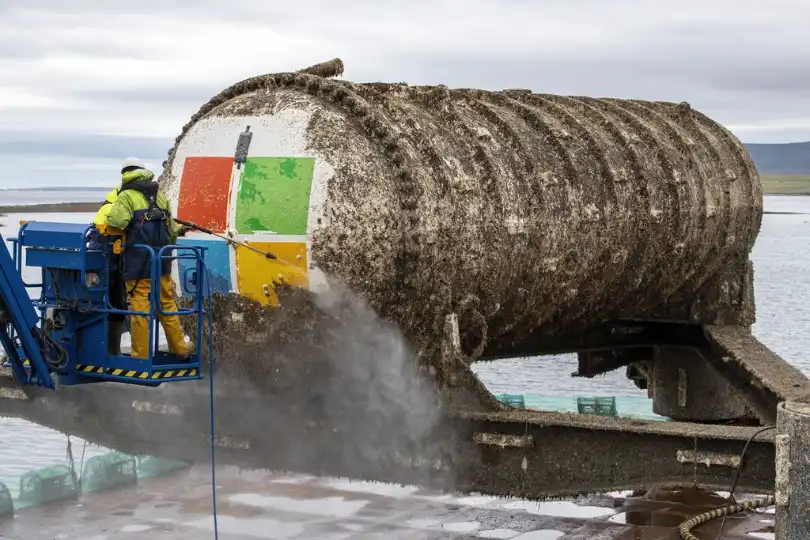
Microsoft’s Undersea Data Center Passes TestNFK Editors - September 17, 2020Orkney Islands, Scotland —(Map)The computer company Microsoft recently ended an unusual experiment by pulling up a data center that has been serving internet requests from under the sea for the last two years. The company says the experiment was a success.The computer company Microsoft recently ended an unusual experiment by pulling up a data center that has been serving internet requests from under the sea (above) for the last two years. The company says the experiment was a success.(Source: Jonathan Banks, Microsoft.)Data centers are usually large buildings full of hundreds or thousands of high-powered computers called servers. You may not think about data centers much, but they’re responsible for everything that we do on the Internet.When we search for something, or load a webpage, our requests follow a bouncing path through the internet until they reach one or many servers, which give us back the information we asked for. As the internet has grown, the need for data centers has also grown.Data centers are usually large buildings full of hundreds or thousands of high-powered computers called servers. The servers use lots of energy. Some energy is needed to make the computers run, but much of the energy is used to keep the servers cool.(Source: Florian Hirzinger – www.fh-ap.com [CC BY-SA], via Wikimedia Commons.)Data centers have many problems. The servers use huge amounts of energy. Some of this is needed to make the computers run, but much of the energy is used to keep the servers cool. If computers overheat, they’re far more likely to break.Microsoft wanted to try putting a data center under the sea, to see if the seawater could naturally cool the computers, saving energy and money.Microsoft wanted to try putting a data center under the sea, to see if the seawater could naturally cool the computers. So the company created a special data center (front) that could fit inside a large tank (rear).(Source: Frank Betermin, Microsoft.)So the company created a special data center that could fit inside a large tank. Microsoft hired a company that builds submarines to design the tank. They wanted the unit to be large enough to hold lots of computers, but small enough to move around on a truck.In 2018, the company lowered their data center into the water near the Orkney Islands. The data center was called “Northern Isles”, since it was located in Scotland’s northern islands.In 2018, the company lowered their data center into the water near the Orkney Islands. The air in the tank was replaced with a gas called nitrogen, to keep oxygen from damaging the computer parts.(Source: Scott Eklund/Red Box Pictures, Microsoft.)The air in the tank was replaced with a gas called nitrogen, to keep oxygen from damaging the computer parts. Special cables provided a high-speed internet connection and electricity. The electricity came from nearby wind and solar energy sources.After a few tests, the Northern Isles data center was put to work. For the last two years, its 864 servers have been helping the internet run. Earlier this year, some of the servers were used to do research on the coronavirus.Special cables provided the data center with a high-speed internet connection and electricity. The electricity came from nearby wind and solar energy sources. Above a windmill in the Orkney Islands, near Microsoft’s Northern Isles datacenter.(Source: Scott Eklund/Red Box Pictures, Microsoft.)In July, the company pulled the data center back to the surface. It was covered with a thin coat of algae, and had some small sea animals clinging to it. But other than that, it was fine.So how did the data center do? Very well, it turns out. Northern Isles used far less energy than a land-based data center would have used over the same amount of time.In July, the company pulled the data center back to the surface. It was covered with a thin coat of algae, and had some small sea animals clinging to it. But other than that, it was fine.(Source: Jonathan Banks, Microsoft.)The conditions were good for the computers, too. Microsoft says that the number of servers that normally have problems on land is eight times higher than the number of servers that broke underwater.The company says that’s probably because there wasn’t any oxygen in the container. It also helped that there were no humans near the servers, so the machines and their cables never got bumped by accident.Microsoft says that the number of servers that normally have problems on land is eight times higher than the number of servers that broke underwater. Above, a Microsoft worker inspects a server from the data center.(Source: Jonathan Banks, Microsoft.)Microsoft is excited about the results produced by its underwater data center, and is eager to apply the lessons they learned to other data centers in the future.Check Yourself0/41. A special high-powered computer that serves internet information is called a _______________.2. Normally data centers use lots of _______________ to run the servers and to cool them.3. How many servers did Microsoft's undersea data center have?4808641,0247684. Microsoft's undersea data center used less energy and was better for the computers than a land-based data center.True FalseMicrosoft's experiment seemed to work well for one data center. Can you think of any problems that might come up if lots of companies suddenly started putting lots of data centers under the sea?ResetSourceswww.bbc.comarstechnica.comwww.theverge.comgizmodo.comwww.zdnet.comnews.microsoft.comnews.microsoft.comOrkney Islands, ScotlandView Larger MapShare:This week marks 25 years of humans living in space. On November 2, 2000, three astronauts became the first full-time workers at the International Space Station. Since then, the ISS has never been empty.Is Seeing Believing? AI Videos Look Extremely RealNFK Editors - Nov 5, 2025Over the last year or so, the quality of AI-generated videos has become so good that it’s extremely difficult to tell whether a video is real or not. An English TV channel recently ran a show about AI. At the end of the episode, the “woman” presenting the show announced that she wasn’t real.
 Technology
NASA Wants Help Labeling Mars
NASA Wants Help Labeling MarsNFK Editors - July 7, 2020NASA is asking people to help it label thousands of photos from Mars. The labels will be used to train a computer system to recognize different surfaces on Mars. This will help NASA drive its rovers safely for longer periods of time.Learning more about the makeup of the land on Mars is very important for protecting NASA’s rovers on the red planet. In 2009, a rover called Spirit got stuck in a sand trap on Mars and never managed to get out.NASA’s Curiosity Rover has been on Mars for eight years. In that time, it has sent back hundreds of thousands of pictures, as well as information that has helped scientists get a much better understanding of what Mars is really like.NASA’s Curiosity Rover (above) has been on Mars for eight years. In that time, it has sent back hundreds of thousands of pictures and other information that has helped scientists understand Mars better.(Source: NASA/JPL-Caltech/Malin Space Science Systems, Julian Herzog [Public domain], via Wikimedia Commons.)But Curiosity faces a problem – its wheels are wearing out, and there’s no chance of getting them replaced.During its time on Mars, the 8,583-pound (3,893-kilogram) rover has only driven about 14 miles (22.5 kilometers). But it has covered some extremely rough ground. The tread on its wheels is wearing out. (The tread is the part that helps the wheel grip the ground.)During its time on Mars, the 8,583-pound (3,893-kilogram) rover has only driven about 14 miles (22.5 kilometers). But it has covered some extremely rough ground. The tread on its wheels is wearing out. The broken tread can be seen above.(Source: NASA/JPL-Caltech/MSSS [Public domain], via Wikimedia Commons.)To make the wheels last as long as possible, NASA needs to get even better at identifying different kinds of Mars ground surfaces, so it can choose smooth paths for Curiosity. The space agency is asking ordinary people to help.NASA wants people to help it label thousands of photos from Mars. The labels will be used to train an artificial intelligence computer program to identify different kinds of ground surfaces on Mars.NASA wants people to help it label thousands of photos from Mars. The labels will be used to train an artificial intelligence computer program to identify different kinds of ground surfaces on Mars. Above, an example image of Mars, labeled (by color).(Source: AI4Mars.)Artificial Intelligence (AI), sometimes known as “deep learning”, describes computer programs that sort deeply through huge amounts of information. This allows them to find patterns humans may not have noticed. The program can then use these patterns to correctly identify things it’s never “seen” before.But in order for NASA’s AI system to automatically be able to tell the difference between sand, dirt, and rocks on Mars, it needs lots of training information. That means lots of labeled examples to learn from.NASA is working with Zooniverse, a website that allows scientists to get help from large groups of ordinary people. The two have set up a special site called AI4Mars.In order for NASA’s AI system to automatically be able to tell the difference between sand, dirt, and rocks on Mars, it needs lots of training information, and lots of labeled examples to learn from. The website AI4Mars was set up to help solve that problem.(Source: AI4Mars.)Visitors to the site are taught how to identify different kinds of ground on Mars. There are four different categories: sand, soil (packed dirt), large flat rocks, and big rocks rising out of the ground. Then visitors are asked to draw outlines on pictures of Mars, and label the outlined areas.So far, the project is about 34% complete. Nearly 4,000 volunteers have labeled around 140,000 areas in photos of Mars.Visitors to the site are taught how to identify different kinds of ground on Mars. So far, the project is about 34% complete. Nearly 4,000 volunteers have labeled around 140,000 areas in photos of Mars.(Source: NASA/JPL-Caltech.)If NASA can improve its computer system to better recognize Mars rocks, it will allow them to drive Curiosity on paths less likely to cause damage to its wheels. The information should also help keep Curiosity from getting stuck in the sand.The system won’t only help Curiosity, it will also help protect any of NASA’s future rovers as well. NASA is planning on sending a new rover called Perseverance to Mars later this summer.To help NASA label its Mars images, visit the AI4Mars site.Check Yourself0/41. What's the name of NASA's rover that got stuck in the sand?2. Though Curiosity has only driven about 14 miles (22.5 kilometers), the _______________ on its wheels is wearing out.3. Identifying the ground surface on Mars will help NASA choose _______________ paths for the Curiosity Rover.4. Which is NOT one of the Mars ground surface types that scientists hope to identify?soil (packed dirt)sandgrassy fieldlarge flat rocksAre you curious about Mars? What would you most like to learn about and why?ResetSourceswww.smithsonianmag.comscience.nasa.govwww.space.comphys.orgwww.nbclosangeles.comwww.zooniverse.orgShare:When NASA sends its new rover blasting off to Mars in July, it will carry the name “Perseverance”. The name was suggested by Virginia middle-school student Alexander Mather, who won NASA’s “Name the Rover” contest.You might be interested in…Scientists Surprised by Clever Fishing WolfNFK Editors - Dec 3, 2025In 2021, the Heiltsuk Nation in Canada set traps to catch invasive European green crabs. The traps kept getting destroyed, and no one knew how. When scientists set up a camera to learn what was going on, they got a surprise: a clever wolf had used a series of complicated steps to get food from the trap.ISS Celebrates 25 Years of People Living in SpaceNFK Editors - Nov 6, 2025This week marks 25 years of humans living in space. On November 2, 2000, three astronauts became the first full-time workers at the International Space Station. Since then, the ISS has never been empty.Is Seeing Believing? AI Videos Look Extremely RealNFK Editors - Nov 5, 2025Over the last year or so, the quality of AI-generated videos has become so good that it’s extremely difficult to tell whether a video is real or not. An English TV channel recently ran a show about AI. At the end of the episode, the “woman” presenting the show announced that she wasn’t real.40 Years of Making Software “Free”NFK Editors - Oct 8, 2025The Free Software Foundation celebrated its 40th birthday last Saturday. First started in 1985, the FSF has helped shape the digital world we live in today. Its ideas about free software inspired the open‑source movement; now open‑source programs run on countless computers, phones, and devices around the globe.
 Technology
Japan Tries Out See-Through Public Toilets
Japan Tries Out See-Through Public ToiletsNFK Editors - August 27, 2020Tokyo, Japan —(Map)In recent years, Japan has had many advanced and unusual toilets, including some with automatic lids and self-warming seats. Now one area of Tokyo is trying something completely new – public toilets with see-through walls.To be fair, the walls of the new public toilets aren’t always transparent (see-through). They are made of a special “smart glass”. When someone enters the toilet and locks the door, the glass becomes opaque – it clouds over so that no one can see in. When the door is unlocked, the glass clears up again.The walls of the new public toilets aren’t always transparent. They are made of a special “smart glass”. When someone enters the toilet and locks the door, the glass becomes opaque. When the door is unlocked, the glass clears up again.(Source: Satoshi Nagare, The Nippon Foundation.)The restrooms were designed by award-winning architect Shigeru Ban. Mr. Ban has also designed houses, large meeting centers, churches, and museums.The idea of a transparent public toilet may sound unusual, but Mr. Ban believes the see-through walls solve two problems. Without ever entering the restroom, people can now check to see how clean it is, and whether anyone else is using it.Embed from Getty ImagesThe idea of a transparent public toilet may sound unusual, but Mr. Ban believes the see-through walls solve two problems. Without ever entering the restroom, people can now check to see how clean it is, and whether anyone else is using it.The smart glass that Mr. Ban chose for the walls has already been used in office buildings where privacy is needed from time to time. The secret to the glass is that a small electric current can change the way the crystals in the glass line up, switching the glass between opaque and transparent.The new toilets have been built in two parks in Tokyo, which opened to the public this month. Mr. Ban points out that because the restrooms are lit up at night, they help provide light for the parks where they are located. Mr. Ban says the restrooms light up the park “like a beautiful lantern”.Mr. Ban points out that because the restrooms are lit up at night, they help provide light for the parks where they are located. Mr. Ban says the restrooms light up the park “like a beautiful lantern”.(Source: Satoshi Nagare, The Nippon Foundation.)So far, the public has had mixed reactions to the see-through restrooms. Some people are excited to use the unusual, brightly colored restrooms. Others worry that the walls might not work properly, and could allow them to be seen when they’re using the toilet.Mr. Ban’s transparent toilets are just one of several new public toilet designs that will be installed across Tokyo in the coming months as part of the Tokyo Toilet project. A group called the Nippon Foundation asked 16 designers and architects to come up with new designs to improve the image of public restrooms in Tokyo.A group called the Nippon Foundation asked 16 designers and architects to come up with new designs to improve the image of public restrooms in Tokyo. Above, the Wonderwall public toilet, designed by Masamichi Katayama.(Source: Satoshi Nagare, The Nippon Foundation.)The project follows a huge push by Japan to upgrade public restrooms across the country. Before 2017, around 40% of public restrooms still used squat toilets, which are common in Asia. A squat toilet is like a hole in the floor that you squat over, instead of sitting down on a seat.Between 2017 and 2019, over 300 public restrooms were upgraded. The goal was to change all public restrooms to include sitting toilets before the Olympics. The Olympics were originally planned for this summer, but because of the coronavirus, the games have been delayed by a year.Japan has been working to upgrade public restrooms across the country. Before 2017, around 40% of public restrooms still used squat toilets. A squat toilet (above) is like a hole in the floor that you squat over, instead of sitting down on a seat.(Source: Ryuta Ishimoto [CC BY-SA], via Wikimedia Commons.)For many people in Japan, the important part of improving public restrooms isn’t just about changing styles. It means making sure they are clean and well-lighted.For now, Mr. Ban’s new toilets are both. And if that ever changes, you’ll be able to tell without even going inside.Did You Know…?A common complaint in Japan is that public restrooms often run out of soap. Some people say they would rather have soap than fancy new restrooms.Check Yourself0/41. When the restroom is empty, the walls are see-through, but when the restroom is being used, they turn opaque.True False2. The transparent restrooms are designed to let you see, without going inside, how _______________ the restroom is and whether anyone is using it..3. A squat toilet is like a _______________ in the floor that you squat over.4. Japan worked to upgrade many of its public restrooms before _________.the 2020 summer Olympicsthe coronavirusthey fell downthey bought any soapWould you like to try out the new transparent bathrooms? Why or why not?ResetSourceswww.nytimes.comwww.laht.comwww.theguardian.comwww.npr.orgwww.cbc.caedition.cnn.comwww.forbes.comwww.nippon-foundation.or.jptokyotoilet.jpTokyo, JapanView Larger MapShare:On Sunday, a group of thieves used a truck with a ladder on it to get into the Louvre museum in Paris. They then broke into display cases and stole several important items from the French crown jewels. So far, no one has been arrested.Leadership Changes in Japan, France, & the Czech RepublicNFK Editors - Oct 7, 2025Today, NewsForKids.net looks at leadership changes in Japan, France, and the Czech Republic. Sanae Takaichi is likely to become Japan’s first female prime minister. In France, Sebastien Lecornu steps down as prime minister the day after announcing his cabinet. And right-wing politician Andrej Babis may become the Czech Republic’s next prime minister.
 Technology
MIT’s Smart Diaper Knows When It’s Wet
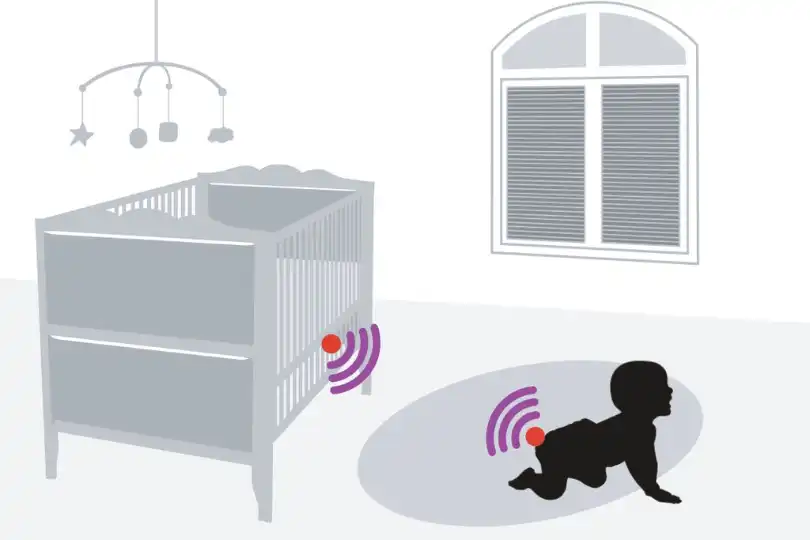
MIT’s Smart Diaper Knows When It’s WetNFK Editors - February 18, 2020Scientists at MIT have developed a “Smart Diaper” that can call for a change when it’s wet. Adding the technology to the diapers wouldn’t cost much and could improve both comfort and health care.Though many disposable diapers come with a strip that changes color when the diapers are wet, it’s often hard to tell for sure without opening the diaper up.Scientists at MIT have developed a “Smart Diaper” that can call for a change when it’s wet. Adding the technology to the diapers wouldn’t cost much and could improve both comfort and health care. The diaper above is not the Smart Diaper.(Source: Ste Elmore, via Flickr.com.)Some companies have offered fancy electronic solutions for detecting wet diapers, but those devices aren’t cheap, and need to be cleaned by hand before they can be used again.Scientists at MIT decided to explore using cheap tags known as RFID tags. RFID stands for “radio frequency identification”. The tags are so common that you may see or use several every day without realizing it.RFID tags are very common. They are part of many bus or subway cards, like the Mexico City Metro card above. They can be used to lock or unlock doors, and are also used to electronically collect tolls on highways.(Source: ProtoplasmaKid [CC BY-SA], via Wikimedia Commons .)RFID tags are commonly used in stores for keeping track of products. They are also part of many bus or subway cards. They can be used to lock or unlock doors, and are also used to electronically collect tolls on highways. The tags are cheap, so they can be used once and thrown away.Even better, they don’t need batteries. Instead, their antennas draw power from radio waves sent by nearby RFID readers. When RFID tags are made active by a reader, they send back a simple code stored in a chip inside the tag.Stores use RFID tags to keep track of products. The antennas draw power from radio waves from nearby RFID readers and send back the code stored in the tag’s chip. Above are pieces of an RFID sticker. The antenna wraps around the chip in the center.(Source: Anton, CC BY-SA], via Wikimedia Commons .)What’s unusual in the MIT project is that the RFID tags aren’t just being used for identification, but as sensors. The scientists found a tricky way to do that.They are using the part of the diaper that soaks up pee as the antenna – but it only becomes an antenna when it’s wet. That means that a dry diaper doesn’t send out any signal. But as soon as it gets wet, the diaper antenna can send out a signal with the RFID chip’s code.The scientists say that adding the RFID tag will only cost about 2 cents per diaper.MIT’s project uses RFID tags as sensors. When wet, the RFID tag in the diaper can send out a signal to an RFID reader up to 1 yard (1 meter) away. MIT created this picture showing how their system will work.(Source: [CC BY-NC-ND 3.0], MIT.)The diaper can send a signal to an RFID reader up to 1 yard (1 meter) away. An RFID reader connected to the internet could announce the wet diaper in many different ways, such as in a message or through an app.The new technology wouldn’t just help babies, the researchers point out. Many older people and people who have trouble moving also wear diapers. Changing wet diapers quickly can help prevent rashes and other health problems.The MIT scientists believe the technology could be very handy in a hospital where one nurse needs to care for many patients or babies.(Source: Sergiomrm [CC BY-SA], via Wikimedia Commons.)The MIT scientists believe the technology could be very handy in a hospital where one nurse needs to care for many patients or babies.And if the Smart Diaper ever fails, there’s always the backup system – a crying baby.Sourcesnews.mit.eduwww.bostonglobe.comwww.theverge.comwww.msn.comShare:This week marks 25 years of humans living in space. On November 2, 2000, three astronauts became the first full-time workers at the International Space Station. Since then, the ISS has never been empty.Is Seeing Believing? AI Videos Look Extremely RealNFK Editors - Nov 5, 2025Over the last year or so, the quality of AI-generated videos has become so good that it’s extremely difficult to tell whether a video is real or not. An English TV channel recently ran a show about AI. At the end of the episode, the “woman” presenting the show announced that she wasn’t real.
 Technology
Girls Takeover: Girls Try Out Jobs As Leaders
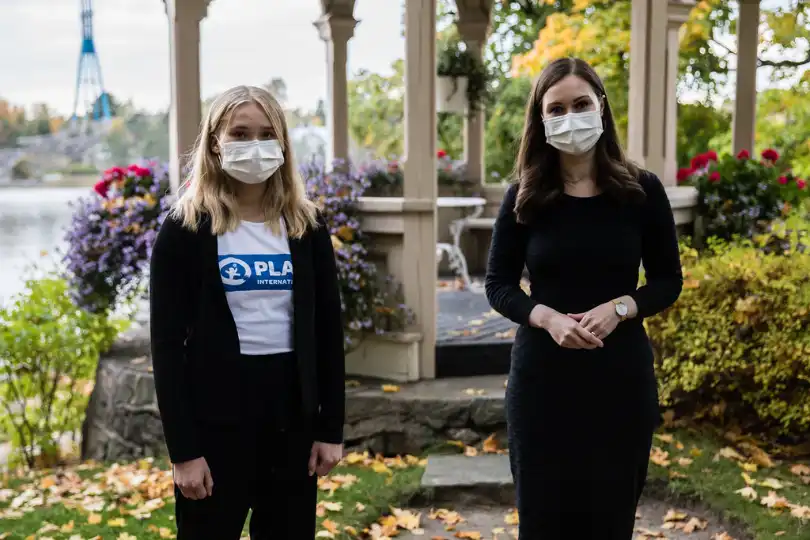
Girls Takeover: Girls Try Out Jobs As LeadersNFK Editors - October 9, 2020Helsinki, Finland —(Map)On Wednesday, 16-year-old Aava Murto took over for a day as prime minister of Finland. The move was part of an international effort called “Girls Takeover”, designed to bring attention to the rights of girls.Finland’s prime minister, Sanna Marin, handed over the position to Aava and showed her how things worked. Though Aava didn’t make any laws, she did meet with politicians, speak to reporters, and give a speech.On Wednesday, 16-year-old Aava Murto (left) took over from Sanna Marin (right) for a day as prime minister of Finland. The move was part of an international effort called “Girls Takeover”, designed to bring attention to the rights of girls.(Source: Finnish Government, via Flickr.com.)Girls Takeover is a global program run by a group called Plan International. The program allows girls around the world to temporarily take over positions normally held by leaders of all different kinds.This is Finland’s fourth year taking part in the program. In addition to Aava taking over as prime minister, other girls took charge of other businesses, including a magazine, a university, and Rovio Entertainment, the company behind the Angry Birds video game.Other girls took charge of other businesses in Finland, including a magazine and a university. Above, 16-year-old Dristi (left) took over from Kati Levoranta (right) as the head of Rovio Entertainment, the company behind the Angry Birds video game.(Source: Sini Leskinen, Plan International.)This year, the focus of Girls Takeover is on equality for girls in technology. Aava normally spends a lot of her time working to promote climate action and human rights. But on Wednesday, she focused on technology in her speech.“Inequality affects many of us girls globally and impacts our lives in a variety of ways,” she said. Aava pointed out that many people assume that boys are interested in technology and that girls aren’t, which can make it harder for girls to master these skills.Aava said that since up to 90% of jobs in the future will rely on digital skills, it’s important to make it easy for everyone to develop these abilities. Aava notes that this is especially important in poorer countries where technology isn’t as cheap or as common.(Source: Finnish Government, via Flickr.com.)Aava said that since up to 90% of jobs in the future will rely on digital skills, it’s important to make it easy for everyone to develop these abilities. Aava notes that this is especially important in poorer countries where technology isn’t as cheap or as common.“Girls, too, have a digital future,” she said, “And that is why girls should have a voice in technology.”Many of the activities for Girls Takeover haven’t happened yet. That’s because the day is linked with the United Nations’ International Day of the Girl, which is celebrated on October 11. This year, that falls on a Sunday.In the Dominican Republic, 15-year-old Lorena (center) took over as mayor of Santo Domingo, replacing the current mayor, Carolina Mejía Gomez. She met with several politicians during the day to share her ideas about the needs of girls and teenagers.(Source: Plan International.)Several other countries around the world are taking part in Girls Takeover, including the Dominican Republic, Kenya, Paraguay, Peru, Sudan, and Vietnam.In the Dominican Republic, 15-year-old Lorena took over as mayor of Santo Domingo, replacing the current mayor, Carolina Mejía Gomez. She met with several politicians during the day to share her ideas about the needs of girls and teenagers in Santo Domingo.Mary (center), who’s 18, took over from Joe Mucheru (right) as Kenya’s Cabinet Secretary in the Ministry of Information and Communications. Mary pointed out that girls need to feel safe online.(Source: Plan International.)Mary, who is 18 years old, took over from Joe Mucheru as Kenya’s Cabinet Secretary in the Ministry of Information and Communications. Mary pointed out that many girls feel harassed or mistreated on the internet. She said that this needs to stop, since girls need to feel safe online.In Paraguay, Diana (top left) took over as the Minister of Children and Adolescents. During her day, she took part in remote meetings with others in the ministry. Diana highlighted how important it is for everyone to have a good connection to the internet.(Source: Plan International.)In Paraguay, Diana took over as the Minister of Children and Adolescents. During her day, she took part in remote meetings with others in the ministry.Like Aava, Diana highlighted how important it is for everyone to have a good connection to the internet – something that’s even more important now, with so many students learning from home.Did You Know…?In the next few days, many more girls will be taking part in Girls Takeover. You can see more examples of their experiences on Plan International’s interactive map.Check Yourself0/41. Aava Murto took over as the prime minister of _______________ as part of a program called Girls Takeover.2. During Girls Takeover, girls get to spend a day as the _______________ of important businesses and other organizations.3. This year, the focus of Girls Takeover is on equality in ________.sportsmoneytechnologyjobs4. Aava mentioned a study that said up to ______ of jobs in the future will require digital skills.90%50%75%10%How do you think taking on positions of power changes the ideas girls have about the things they can do? How do you think it changes boys' ideas about what girls can do?ResetSourceswww.washingtonpost.comwww.dw.comwww.bbc.co.ukwww.scmp.comvaltioneuvosto.fiplan-international.orgHelsinki, FinlandView Larger MapShare:
 Technology
Companies Rush to Make Ventilators
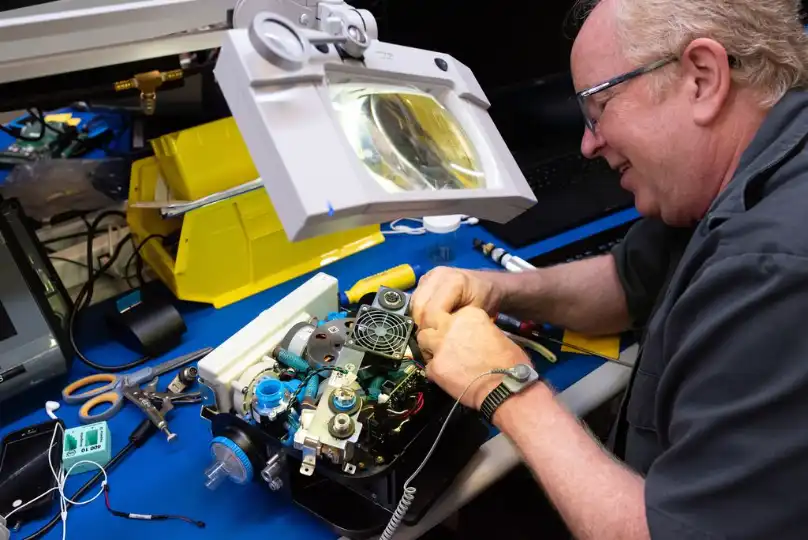
Companies Rush to Make VentilatorsNFK Editors - March 31, 2020This article is the first in a series about different ways people are working hard to help bring the challenges of the coronavirus pandemic under control.Worldwide, doctors, nurses, and other health care workers are struggling to find the special equipment they need to deal with the coronavirus. Now people around the world are moving quickly to tackle these problems.Because the COVID-19 pandemic has affected so many people so quickly, hospitals worry they may not have enough ventilators to keep up.Ventilators are machines that can move air into and out of the lungs of a person who can’t breathe well on their own. Because COVID-19 has affected so many people so quickly, hospitals worry they may not have enough ventilators to keep up.(Source: Quinn Dombrowski, via Flickr.com.)Ventilators are machines that can move air into and out of the lungs of a person who can’t breathe well enough on their own. Most cases of COVID-19 don’t require a ventilator. But in some severe cases, especially among older people, ventilators are needed.Ventilators cost huge amounts of money – as much as $30,000 – so companies normally don’t make that many of them. Now countries around the world are racing to make more.In Italy, one of the countries that’s been hit hardest, only one company makes ventilators. The company makes just 125 machines a month. The government has now ordered the company to make 500 a month and has sent soldiers to help out.Ventilators cost huge amounts of money – as much as $30,000 – so companies normally don’t make that many of them. Now countries around the world are racing to make more.(Source: أمين [CC BY-SA], via Wikimedia Commons.)The United States (US) currently has more COVID-19 cases than any other country. Health experts worry that hospitals could soon need more ventilators than there are.With its factories closed because of the pandemic, car maker General Motors (GM) has been working hard since mid-March to change some of its factories to build ventilators instead of cars.GM is working with a ventilator company called Ventec (above). Ventec only produces about 200 ventilators a month. Now, working together, the two companies hope to make as many as 10,000 ventilators each month.(Source: Ventec Life Systems.)GM is working with a ventilator company called Ventec. Ventec only produces about 200 ventilators a month. Now, working together, the two companies hope to make as many as 10,000 ventilators each month.The companies had to scramble to find all the parts they’ll need to make 10,000 machines a month, but they say the new ventilators should be on their way to hospitals before the end of April.The companies had to scramble to find all the parts they’ll need to make 10,000 machines a month, but they say the new ventilators should be on their way to hospitals before the end of April. Above, a Ventec ventilator in a hospital.(Source: Mark Stehle/AP Images, Ventec Life Systems.)Elon Musk, who runs the Tesla car company, has promised to give hospitals in New York hundreds of ventilators he bought in China. New York is the US state hit hardest by the pandemic. Mr. Musk says he’s also working to convert one of his factories in New York to make ventilators.In the United Kingdom (UK), inventor James Dyson says he’s come up with a new design for a ventilator that’s quick and easy to produce. That will make it simpler for factories to make many of them. The UK government has already ordered 10,000 of the machines, which Mr. Dyson calls CoVent. The inventor says he plans to give 5,000 of his ventilators away to other countries.Inventor James Dyson (above) says he’s come up with a new design for a ventilator that’s quick and easy to produce. That will make it simpler for factories to make many of them. The UK government has already ordered 10,000 of the machines, which Mr. Dyson calls CoVent.(Source: The Royal Society [CC BY-SA 3.0], via Wikimedia Commons.)Tackling the problem from another angle, MIT has come up with a cheap way of making ventilators which brings the cost down to around $500. The university is releasing the design information so that experts in other parts of the world can make the ventilators.MIT’s ventilator, called the E-Vent, is based on an old student project. It may be especially useful in poorer countries. Like most ventilators, the E-Vent works automatically. But the bag it uses to move air was originally designed to be pressed by a doctor or nurse. That could come in handy in emergencies or in places where the electricity sometimes goes out.MIT has come up with a cheap way of making ventilators which lowers the cost to about $500. The university is releasing the design information so that experts around the world can make them. Above, MIT’s system is hooked up to a dummy to show how it works.(Source: MIT.)NewsForKids.net has these COVID-19 resources:• Overview of COVID-19• Coronavirus Words Explained• Collection of our articles on COVID-19• Regular, detailed COVID-19 updatesCheck Yourself0/41. Because so many serious COVID-19 patients need help breathing, hospitals worry they might not have enough _______________.2. General Motors is working on making ventilators. What does it normally make?carsbicyclesairplaneslight bulbs3. General Motors and Ventec hope to make 10,000 ventilators a month. How many ventilators does Ventec currently make?4. MIT has come up with a cheap way of making ventilators that costs just $_______________.What sorts of changes do you think might be needed to turn a car factory into one that makes medical equipment?ResetSourceswww.voanews.comwww.cnn.comwww.nytimes.comwww.zdnet.comwww.cnet.comwww.bbc.comnews.mit.eduShare:Scientists at Loughborough University in the United Kingdom have created what they call “the world’s smallest violin”. The violin is made of metal and is so tiny that it can only be seen with a powerful microscope. The project was designed to test new technology for building extremely small things.
 Technology
Delivering the Internet With Balloons in Kenya
Delivering the Internet With Balloons in KenyaNFK Editors - July 9, 2020Nairobi, Kenya —(Map)A company called Loon is using balloons to deliver the internet to people across Kenya. The company believes its system will be a cheap, reliable way to bring internet services to people who live in remote areas.Loon began as a special project inside of Google, and was later turned into its own company. For its work in Kenya, Loon is partnering with Telkom Kenya, Kenya’s third-largest cell service company.A company called Loon is using balloons to deliver internet service in Kenya. Loon believes its system will be a cheap, reliable way to bring the internet to people in remote areas.(Source: Loon.)Why balloons?In developed countries, there are many ways of delivering the internet, such as through telephone or cable lines, or through cell towers that have been built over the years. In less developed countries, these systems are limited. It would be far too slow and cost too much to start building them now.The idea behind Loon is that by using balloons as floating cell towers, internet services can be delivered easily and cheaply, even to remote areas. That’s appealing in Africa, where in 2019, less than 30% of the people were able to connect to the internet.Loon’s balloons are about as big as a tennis court. The balloons float about 12 miles (20 kilometers) above the Earth – higher than most planes fly.(Source: Loon.)Loon’s balloons are basically floating cell towers. And they are massive – each is about as big as a tennis court. The balloons float about 12 miles (20 kilometers) above the Earth – higher than most planes fly.The huge plastic balloons can float for up to 100 days, running off of solar power. Loon is using 35 balloons to provide internet service to around 19,000 square miles (50,000 square kilometers) of Kenya.Loon’s balloons are basically floating cell towers. The huge plastic balloons can float for up to 100 days, running off of solar power. Above, the equipment that’s carried by the balloons.(Source: Loon.)Loon has been slowly building the project in Kenya, testing it over the last two years. Though most users didn’t realize it, Loon’s balloons have already brought internet service to around 35,000 people. Those people used the service to watch videos, look at websites, and make video and voice calls.Though most users didn’t realize it, Loon’s balloons have already brought internet service to around 35,000 people over the last two years. Above, people from Telkom Kenya check out Loon’s service in a remote area.(Source: Loon.)Some people have complained that Loon’s service covers areas of Kenya that already have some cell phone service, instead of remote, poorly-connected areas in the north.Others have suggested that Loon should have started in a completely different country, since Kenya is better connected than many other countries in Africa. Loon says that Kenya was a great place to start because the government has been very willing to try out new ideas.Some people say Loon’s service should cover even more remote and poorly-connected areas of Kenya. Others think Loon should have started in a completely different country, since Kenya is better connected than many other African countries.(Source: Loon.)Before this, Loon’s balloons were used mainly to provide internet connections during emergencies. For example, Loon brought internet service to Puerto Rico after its cell towers were destroyed by Hurricane Maria in 2017. It also brought emergency service to areas of Peru following a 2019 earthquake.Loon isn’t the first company to try unusual methods of bringing internet service to remote areas. Facebook tried to use drones to provide internet service in parts of Africa, but gave up after many challenges.Loon plans to use its balloons in other parts of the world, as well. The company already has deals to provide service in Mozambique and Peru. Many people will be watching the project carefully to see if it succeeds in a way that could be repeated in other countries.(Source: Loon.)After Kenya, Loon plans to use its balloons in other parts of the world, as well. The company already has deals to provide service in Mozambique and Peru.Many people will be watching Loon’s Kenya project carefully to see if it succeeds in a way that could be repeated in other countries.Did You Know…?The balloons for Loon’s Kenya project were actually launched in the US and slowly flown into place in Kenya.Check Yourself0/41. Loon is using balloons as floating _______________ towers.2. In 2019, _________ of the people in Africa were able to connect to the internet.less than 30%around 35%nearly 50%47%3. Loon hopes its balloons will provide internet service to _______________ areas where it is hard to get internet connections in other ways.4. The cell equipment carried by Loon's balloons runs off of _______________ power.In what ways do you think being connected to the internet could improve life in remote areas? Are there any ways in which it could cause problems?ResetSourceswww.nytimes.comwww.cnn.comwww.theverge.comtechcrunch.comwww.zdnet.commedium.comNairobi, KenyaView Larger MapShare:Scientists at Loughborough University in the United Kingdom have created what they call “the world’s smallest violin”. The violin is made of metal and is so tiny that it can only be seen with a powerful microscope. The project was designed to test new technology for building extremely small things.Rubik’s Cube Record Smashed by College StudentsNFK Editors - Jun 26, 2025Students at Purdue University have created a robot that can solve a Rubik’s Cube faster than any robot ever. The robot, which they call “Purdubik’s Cube”, solves the cube in just 0.103 seconds. That’s faster than the time it takes to blink your eyes.
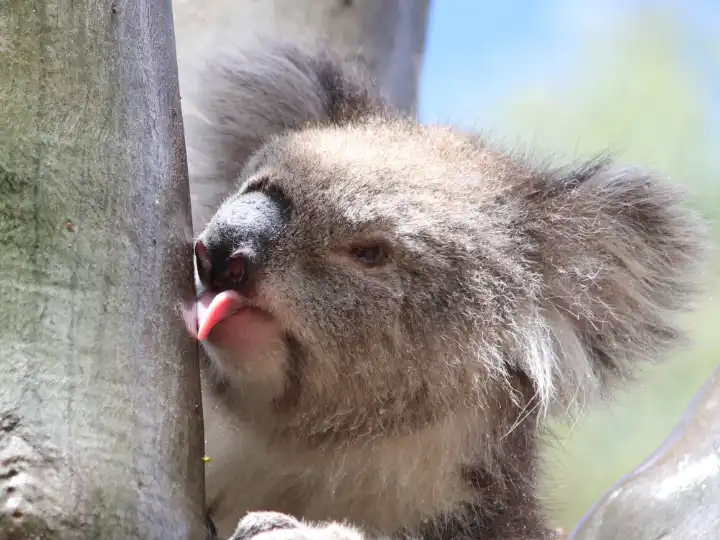 Technology
Animal Notes: Rare Bear, Koalas, & FaceTiming Eels
Animal Notes: Rare Bear, Koalas, & FaceTiming EelsNFK Editors - May 10, 2020Koalas Lick Wet Trees to get WaterScientists have recently discovered that koalas often get water by licking rain from tree trunks. That’s new information. Until recently, scientists believed that koalas got all of the liquid they needed from eating the leaves of eucalyptus trees.The discovery came as a result of many years of “citizen science” – asking ordinary people to report on what they saw. In over 12 years of reports, every time someone watched koalas in the rain, they saw the behavior. One koala was even seen licking a tree for over half an hour.Scientists have recently discovered that koalas often get water by licking rain from tree trunks. That’s new information. Until recently, scientists believed that koalas got all of the liquid they needed from eating the leaves of eucalyptus trees.(Source: Janine Duffy, Echidna Walkabout [CC BY-SA], via Wikimedia Commons.)In Australia’s recent heatwaves, koalas have been seen looking for unusual sources of water. They’ve even taken water from bikers.But Australia was also going through a serious drought. If koalas normally depend on wet tree trunks for water, it makes sense that they have to look for other sources of water during long dry periods.One reason the discovery wasn’t made earlier is fairly clear – people don’t like to go out in rainy weather to watch koalas.Brown Bear Spotted for the First time in 150 YearsFor two years, the film-making company Zeitun Films left “photo-trapping” cameras in a national park called Invernadeiro in Galicia, Spain. The company was collecting wildlife video to include in a movie they are working on, called Montaña ou Morte (Mountain or Death).The film crew and experts from the park were surprised to find images of a brown bear in the videos. The park experts say that it is probably the first brown bear to pass through the area in 150 years.A film crew’s “photo-trapping” cameras have caught videos of a rare brown bear in a national park in Galicia, Spain. Experts say the male bear (shown above scratching its back on a tree) may be the first brown bear to pass through the area in 150 years.(Source: Zeitun Films, via YouTube.)In the past, brown bears were known to live in the area, but they are now in danger of dying out. Brown bears have been protected in Spain since 1973.Park experts said that the bear was a male and was probably between three and five years old. They believe the bear probably spent the winter in the park.The discovery was exciting news for the park’s workers, since it meant that after years of efforts to restore the park as a natural area, it can now support bears again.FaceTiming with Garden EelsSumida Aquarium in Japan is facing an unusual challenge because of the lack of human visitors during the lockdown. The aquarium’s garden eels have begun to disappear every time a keeper comes by. That’s making it difficult to check on the health of the eels.Disappearing underground when something comes near is normal behavior for garden eels, but the eels at the aquarium had become used to having visitors every day. Recently, though, with no humans visiting, their habits seem to be changing back.Sumida Aquarium in Japan has asked people to FaceTime its garden eels (above) to get them used to seeing humans again. The aquarium’s garden eels have begun to disappear every time a keeper comes by. That’s making it difficult to check on the health of the eels.(Source: Hal 0005 [CC BY-SA], via Wikimedia Commons.)So the aquarium tried an unusual solution. Earlier this week, it invited people to FaceTime the eels. The aquarium set up iPads facing the eel tank, and asked people at home to make video calls to their eels. The aquarium asked people to show their faces and wave. People were encouraged to talk, but not shout.The goal was to get the eels used to seeing human faces again. So far the aquarium has not reported on whether the project was a success.Sourceswww.theverge.comwww.theguardian.comwww.theguardian.comwww.cnn.comen.wikipedia.orgwww.voanews.comwww.theguardian.comedition.cnn.comShare:
 Technology
NEOWISE: Rare Comet Can be Seen With Bare Eyes
NEOWISE: Rare Comet Can be Seen With Bare EyesNFK Editors - July 17, 2020There’s a new sight in the sky these days – the newly-discovered Comet NEOWISE is flying past the Sun. This marks the first time since the 1990s that people have had a chance to see a comet with their bare eyes.A comet is basically a ball of dirty ice that orbits the sun. As the comets come close to the sun, the sun melts some of the ice, which forms a tail behind the comet as it flies through space.There’s a new sight in the sky these days – the newly-discovered Comet NEOWISE (above) is flying past the Sun. This marks the first time since the 1990s that people have had a chance to see a comet with their bare eyes.(Source: SimgDe [CC BY-SA], via Wikimedia Commons.)Most comets have an orbit that looks like a flattened circle. Comets spend most of their time moving slowly, far away from the Sun. As they pass the Sun, they speed up.The size and shape of a comet’s orbit affect how long it takes to complete its orbit. Halley’s comet is a famous comet that comes around once every 75 years. But the orbit of NEOWISE is so flat and stretched out that the last time it was here was about 6,800 years ago.Because of the long time it takes to orbit, NEOWISE was only just discovered a couple of months ago. It was spotted in March using a special space telescope run by NASA.Because of the long time it takes to orbit, NEOWISE was only recently discovered, using a special space telescope run by NASA. The first view of Comet NEOWISE came from this string of fuzzy red dots on March 27, 2020.(Source: Courtesy NASA/JPL-Caltech. [Public domain], via Wikimedia Commons.)The name of the telescope system that first spotted the comet is NEOWISE (Near-Earth Object Wide-field Infrared Survey Explorer), so that’s how the comet got its name. Its official name is even less catchy – C/2020 F3.It’s not exactly true that the comet was just discovered. People almost certainly saw NEOWISE around 6,800 years ago, but that was before humans had even invented writing, so there are no records of it passing.NEOWISE is easy to see now because it’s close to the Sun. At its farthest, NEOWISE will be 630 times farther away from the Sun than Earth is. The image above shows part of Comet NEOWISE’s orbit, and its position on April 19, 2020.(Source: NASA [Public domain], via Wikimedia Commons.)NEOWISE is easy to see now because it’s close to the Sun. At its farthest, NEOWISE will be 630 times farther away from the Sun than Earth is. (If you want to do the math, multiply the distance between the Earth and the Sun – 93 million miles (150 million kilometers) – by 630.)NEOWISE actually has two tails. One tail is made of bits of ice melted flying off the comet. The second tail is made of plasma – gas that is charged with electricity. That’s similar to the idea behind a neon light.The icy tail flows straight behind NEOWISE, but the plasma tail is bent toward the Sun because of the Sun’s magnetic field.NEOWISE actually has two tails. One is made of bits of ice. The second is made of plasma – gas charged with electricity. The icy tail flows straight behind NEOWISE, but the plasma tail bends toward the Sun because of the Sun’s magnetic field.(Source: Andy.niko [CC BY-SA], via Wikimedia Commons.)Even at its closest – which will be on July 23 – the comet will still be as far away from the Earth as Mars is. But it should still be bright enough to see, even without binoculars or a telescope.The comet’s brightness will depend on how big the icy tail grows. Lots of ice particles reflecting the Sun’s light could make the comet even brighter.Even at its closest – which will be on July 23 – the comet will still be as far away from the Earth as Mars is. But it should still be bright enough to see, even without binoculars or a telescope.(Source: JochenK2002 [CC BY], via Wikimedia Commons.)The comet is visible in the northern hemisphere (half of the world). The best time to view it is about an hour and a half after sunset, low in the northwest sky. It should be just below the constellation (group of stars) known as Ursa Major (the Big Dipper).The comet is visible in the northern hemisphere. The best viewing time is about 90 minutes after sunset, low in the northwest sky. It should be just below the constellation known as Ursa Major (the Big Dipper) – shown at the bottom of this photo.(Source: Alex Zelenko [CC BY-SA], via Wikimedia Commons.)Did You Know…?Though you won’t need any special equipment to see Comet NEOWISE, you’ll get a much more detailed view if you are able to look at it with binoculars or a telescope.Check Yourself0/41. Comet NEOWISE is a recently discovered comet which becomes visible about once every 6,800 years.True False2. Comet NEOWISE is named for the _______________ system which was used to discover it.3. Comet NEOWISE has two tails. One is made of ice. What's the other one made of?4. Comet NEOWISE is visible from the _________ hemisphere.southernnorthernDoes is seem strange to think that you can see something today that was last seen by people 6,800 years ago? What do you think people thought of the comet back then?ResetSourceswww.nytimes.comwww.theverge.comwww.jpl.nasa.govtheconversation.comwww.smithsonianmag.comphys.orgwww.abc.net.auwww.cbc.caen.wikipedia.orgShare:This week marks 25 years of humans living in space. On November 2, 2000, three astronauts became the first full-time workers at the International Space Station. Since then, the ISS has never been empty.Meteorite That Hit House Is Older Than EarthNFK Editors - Aug 14, 2025When a fireball fell through the sky in the southeastern United States on June 26, it caught the attention of people across seven states. It was a meteor breaking up as it fell through the Earth’s atmosphere. A small part of the space rock tore through a house in Georgia. Scientists now say the meteorite is older than the Earth.Blue Origin Sends Six Women Into SpaceNFK Editors - Apr 16, 2025On Monday, the aerospace company Blue Origin launched its spacecraft RSS Kármán Line on a ten minute trip into space. The spaceship carried the first all-female crew to go into space since Russian astronaut Valentina Tereshkova’s solo mission in 1963.Private Company Makes Perfect Moon LandingNFK Editors - Mar 5, 2025On Sunday, a company called Firefly Aerospace became the first private company to make a perfect landing on the moon. Firefly is working with NASA, and its spacecraft, Blue Ghost, is carrying out several experiments for the space agency.
 Technology
Scientists Invent a Lickable “Taste Display”
Scientists Invent a Lickable “Taste Display”NFK Editors - June 4, 2020Tokyo, Japan —(Map)Scientists at Meiji University in Japan have come up with something they call a “taste display”. The device can create the taste of any chosen flavor when it is pressed against the tongue.Humans are able to identify different flavors through the taste buds on their tongues. If you look at your tongue in a mirror, you’ll see lots of tiny bumps. These aren’t your taste buds, but most of the bumps contain taste buds – hundreds of them.Humans are able to identify different flavors through the taste buds on their tongues. If you look at your tongue in a mirror, you’ll see lots of tiny bumps. Most of the bumps contain hundreds of taste buds.(Source: Anthonylightening [CC BY-SA], via Wikimedia Commons.)Taste buds have tiny openings that take in very small amounts of whatever we’re eating. Special “receptor cells” in the taste buds can then have a chemical reaction to the food, creating one of five basic tastes. The way these basic tastes combine creates the overall flavor of the food we’re eating.The five basic tastes are sweet, sour (or acidic), salty, bitter, and umami. Bitter flavors are sharp, like coffee, unsweetened chocolate, or the peel of an orange or lemon.The five basic tastes are sweet, sour (or acidic), salty, bitter, and umami. Bitter flavors are sharp, like coffee, unsweetened chocolate, or the peel of an orange or lemon. Umami is sometimes called “savory”. Above, a labeled view of the end of the new “taste display”.(Source: Homei Miyashita .)The fifth taste may sound unusual. It wasn’t even given a name until 1908. Umami is sometimes called “savory”. It’s a rich taste, common in soups, gravies, cheeses, and soy sauce. Umami can help bring out other tastes.Together, these five basic tastes create the flavors of everything we eat. Different amounts of these basic tastes create completely different flavors. That’s the main idea behind the “Norimaki Synthesizer” – the new taste display.The five basic tastes create the flavors of everything we eat. Different amounts of these basic tastes create completely different flavors. That’s the main idea behind the “Norimaki Synthesizer” (above).(Source: Homei Miyashita .)The device’s creator, Homei Miyashita, got the idea for calling it a “taste display” from computer screens. Computer screens are made up of thousands of little pixels which are only able to show red, green, or blue. But the color purple, for example, can be displayed by mixing red and blue.The “Norimaki Synthesizer” works roughly the same way, but with tastes. One part of the device is a tube that is held in the hand and touched to the tongue. Inside this tube are five smaller tubes. Each contains a gel with the chemicals needed to create one of the five basic tastes.One part of the device is a tube that is held in the hand and touched to the tongue. Inside this tube are five smaller tubes. Each contains a gel with the chemicals needed to create one of the five basic tastes.(Source: Homei Miyashita .)The tube is covered with copper. When the tip is touched to the tongue, an electric circuit is formed. That electric circuit begins to release tiny amounts of the gels to the taste buds.When the tube touches the tongue with no added electricity, the user can taste all five tastes. But, by using a small box with sliding controls, the amount of different tastes can be lowered, creating different flavors.The researchers have been able to create sweet flavors like a gummy candy and more salty and sour tastes like sushi, simply by moving the sliders around.When the tube touches the tongue, the user can taste all five basic tastes. But, by using a small box with sliding controls, the amount of different tastes can be lowered, creating different flavors. The researchers have created flavors like gummy candy and sushi.(Source: Homei Miyashita .)The device doesn’t create anything you can smell, though. It also can’t produce the effect of spicy foods.The current version of the Norimaki Synthesizer is just a prototype – a rough version to test the idea.Mr. Miyashita believes that in the future, we may be able to share flavors over the internet. He says one day you may be able to see a meal on TV and actually be able to taste it.Check Yourself0/41. There are five basic tastes: sweet, sour, salty, bitter, and umami.True False2. Different amounts of the five basic tastes combine together to create different _______________.3. When the tip of the Norimaki Synthesizer is touched to the tongue, an _______________ circuit is formed.4. Can the Norimaki Synthesizer allow you to smell flavors, too?Yes NoDoes the Norimaki Synthesizer sound interesting to you? If you had one, what would you use it for?ResetSourceswww.hackster.iogizmodo.comwww.meiji.ac.jpwww.dezeen.comwww.digitaltrends.comen.wikipedia.orgTokyo, JapanView Larger MapShare:
 Technology
News Roundup: COVID-19, Voyager 2, & Parents of a 101-Year-Old
News Roundup: COVID-19, Voyager 2, & Parents of a 101-Year-OldNFK Editors - February 15, 2020Coronavirus Gets New Name as China Tests in a New WayThe disease caused by the new coronavirus, which began in Wuhan, China in December, has been given the name COVID-19. “COVI” stands for “coronavirus”, “D” is for “disease”, and the “19” represents the year the virus appeared.The name was carefully chosen by the WHO (World Health Organization) to describe the virus, without blaming any place or group of people.Coronaviruses are a group of viruses that have a halo, or crown-like (corona) appearance when viewed under an electron microscope. Above is the SARS-CoV-2 virus, which causes COVID-19.(Source: NIAID-RML [CC BY-SA], via Wikimedia Commons.)CoronavirusesCoronaviruses are viruses that have a spiky ring around them like a crown when viewed with a powerful microscope. Though there are many coronaviruses which affect animals, before COVID-19, only six coronaviruses were known to affect humans. Four of these cause common colds. The other two cause more serious lung illnesses, and can be deadly.The impact of COVID-19 has continued to grow. There have now been 67,079 cases, and 1,525 deaths. The virus has spread to over 25 countries, but almost all of the cases are in China. At least 8,156 people have gotten the disease and recovered.Though the number of cases has increased greatly this week, that’s partly because China changed the way it counts cases. In the past, China counted cases by actually testing people for the virus. But testing took time and China was running low on the materials needed for testing.So instead, China began looking at the lungs of patients using CT scanners. CT scanners combine X-ray pictures taken from different angles to allow doctors to see inside of someone without surgery.The numbers of cases of COVID-19 jumped suddenly this week as China began to identify cases with CT scanners. They did this because tests were slow and test materials were running low. Above is a US testing kit for COVID-19.(Source: U.S. Centers for Disease Control [Public domain], via Wikimedia Commons.)CT scans can quickly give doctors an idea of which patients might have COVID-19, but the test isn’t certain. That’s why the WHO continues to count cases based on actual test results. Scientists are working hard to find a better, faster way to test for the virus.NASA Fixes Spacecraft from Billions of Miles AwayTo study the outer planets of our Solar System, NASA launched the Voyager 2 in 1977. For the next 12 years, Voyager 2 sent back new information and pictures, leading to many discoveries about the outer planets.To study the outer planets of our Solar System, NASA launched the Voyager 2 in 1977. For the next 12 years, Voyager 2 sent back new information and pictures, leading to many discoveries about the outer planets. This picture of Neptune was taken by Voyager 2.(Source: NASA [Public domain], via Wikimedia Commons.)Since then, Voyager 2 has kept sending back information as it heads even farther away from the sun. In 2018, it left the Solar System. Voyager 2 and its partner, Voyager 1, are the farthest human-made objects in space. Incredibly, NASA is still in touch with the spacecraft.On January 28, Voyager 2 suddenly shut down. NASA believes the spacecraft was using too much power, which caused an automatic shutdown.Recently, NASA’s scientists were able to fix Voyager 2, even though the spacecraft is 11.5 billion miles (18.5 billion kilometers) away. Above is an artist’s idea of what Voyager 2 might look like now.(Source: NASA/JPL-Caltech, via NASA.)By February 5, NASA’s scientists solved the problem, even though Voyager 2 is 11.5 billion miles (18.5 billion kilometers) away. But fixing the problem was a challenge, because of the distance. It takes 17 hours to send a signal to Voyager 2 from Earth, and another 17 hours for the answer to return.UK Wants 101-Year-Old Man’s Parents To Confirm His IdentityGiovanni Palmiero is a 101-year-old Italian man who’s lived in the United Kingdom (UK) since 1966. He recently filled out an application with the UK’s Home Office to stay in the country now that the UK has left the European Union.In response to his application, the Home Office told Mr. Palmiero that his parents would need to confirm who he was.The UK’s Home Office recently told a 101-year-old man that he needed to get his parents to confirm who he was. The problem was a computer error that happened because Mr. Palmiero was more than 100 years old.(Source: Harry Metcalfe, via Flickr.com.)It seems that a computer mistake caused Mr. Palmiero’s birth year to be read as 2019 instead of 1919, meaning the computer thought he was 1 year old.It took a while for the confusion to be sorted out. The Home Office now understands Mr. Palmiero is 101 years old and won’t be coming back with his parents.Sourceswww.npr.orgwww.nytimes.comwww.npr.orgvoyager.jpl.nasa.govwww.inverse.comwww.jpl.nasa.govwww.theguardian.comwww.independent.co.ukShare:This week marks 25 years of humans living in space. On November 2, 2000, three astronauts became the first full-time workers at the International Space Station. Since then, the ISS has never been empty.
 Technology
Fake Turtle Eggs Help Track Down Poachers
Fake Turtle Eggs Help Track Down PoachersNFK Editors - October 6, 2020San Jose, Costa Rica —(Map)Scientists have come up with a high-tech method to help protect endangered sea turtles. Using fake eggs with GPS trackers, researchers were able to track turtle eggs that were stolen and learn the locations of people buying and selling them.There are seven different kinds of marine (sea) turtles in the world. All of them are threatened. Several are in danger of being wiped out completely.Sea turtles lay large groups of eggs, called “clutches”, under the sand on beaches. The eggs face many challenges, both natural and man-made. In Costa Rica, one big threat is poachers – people who take the eggs illegally in order to sell them.Sea turtles lay large groups of eggs, called “clutches”, under the sand on beaches. The eggs face many challenges, both natural and man-made. Above, a clutch of eggs being laid by a Leatherback Sea Turtle.(Source: Bernard DuPont [CC BY-SA], via Wikimedia Commons.)Kim Williams-Guillén is a scientist who works for the University of Michigan and Paso Pacifico, a group that works to protect animals in Costa Rica.After watching a couple of TV police shows, she suddenly had an idea – what if poachers could be located using a fake turtle egg with a GPS tracker inside?Dr. Williams-Guillén presented that idea and it won a $10,000 prize. She then worked with other scientists to create the decoy (fake egg). They use a special material to 3D-print a ball about the size and shape of a squishy ping-pong ball.Scientists 3D-print a ball about the size and shape of a squishy ping-pong ball. The inside of the egg is like a small cell phone. As long as it has a cell signal, the egg can report its location once an hour. Above, a fake egg cut open to show the insides.(Source: Helen Pheasey.)The scientists cut a small slit in the ball so they can put in the electronics. Basically, the inside of the egg is like a small cell phone. It has a battery, a GPS, and a way to connect to cell networks. As long as it has a cell signal, the egg can report its location once an hour.The researchers call the finished device the “InvestEGGator”.The researchers put one InvestEGGator into 101 different turtle nests on four beaches in Costa Rica. About 25% of those nests had eggs stolen. Above researcher Helen Pheasey is shown holding an InvestEGGator on a beach with a sea turtle.(Source: Otto Whitehead.)The researchers put one InvestEGGator into 101 different turtle nests on four beaches in Costa Rica. About 25% of those nests had eggs stolen.Not all of the decoy eggs showed results. A few were left behind, and some others simply didn’t work. But the scientists were able to track five eggs and see where they were taken. In one case the researchers were able to track an egg for 85 miles (137 kilometers).The scientists were able to track five eggs and see where they were taken. In one case the researchers were able to track an egg for 85 miles (137 kilometers). Scientist Helen Pheasey posted this map.The results showed that most eggs were sold to local people. That wasn’t a big surprise, since in Costa Rica, turtle eggs are considered a special food. And though it’s against the law to take them from the beach, it’s not illegal to buy them.In general, people working to solve wildlife crimes are more interested in large criminal groups than in local people having a meal. By tracking the locations where many eggs seem to be bought and sold, researchers think they may be able to help locate more important criminals.The scientists are excited about the results of the InvestEGGator. The test shows that such simple methods can work well. The researchers believe that similar ideas could be helpful in other places as well.(Source: Paso Pacifico.)The scientists are excited about the results of the InvestEGGator. The test shows that such simple methods can work well. The researchers believe that similar ideas could be helpful in other places as well.For example, sharks are often killed in great numbers for their fins. The scientists believe that it might be possible to slip a fake GPS-tracking fin in with many other fins to help protect threatened animals like hammerhead sharks.Check Yourself0/41. There are _______________ different kinds of marine (sea) turtles in the world, and all of them are threatened.2. Scientists were able to track poachers by tricking them into stealing a fake turtle egg that had a GPS tracker inside it.True False3. The researchers put InvestEGGators into 101 different turtle nests. How many of those nests had their eggs taken?over 50%about 25%12%about 85%4. Usually, people working to solve wildlife crimes are mainly interested in catching _____________.a few local peopleimportant criminal groupsThe scientists believe that the idea behind the InvestEGGator could be helpful in other places. Can you think of other ways a similar idea could be used to help protect animals?ResetSourceswww.theguardian.comwww.sciencemag.orgwww.wired.comwww.cnet.comwww.kent.ac.ukpasopacifico.orgwww.sciencedirect.comwww.npr.orgSan Jose, Costa RicaView Larger MapShare:
 Technology
For Real? #1 Movie, Backyard Weather, & Statue Fishing
For Real? #1 Movie, Backyard Weather, & Statue FishingNFK Editors - June 20, 2020Film Makers Use Trick to Create #1 Movie in USOn June 10, a movie called “Unsubscribe” became the surprise #1 movie in the United States. It was watched in a theater in Westhampton Beach, New York by just two people.That probably sounds a little puzzling. Here’s how it worked.Movies get their “box office” ranking by how much money they make in ticket sales. Because of the coronaviruspandemic, most movie theaters in the US are closed, so the box office sales for most films are extremely low.Actor Eric Tabach and film maker Christian Nilsson came up with a plan to beat those low numbers and become #1. Mr. Nilsson wrote a simple 29 minute movie. Mr. Tabach got several friends to help him shoot the movie over the video-calling program Zoom in just five days.Actor Eric Tabach (left) and film maker Christian Nilsson (right) came up with a tricky plan to make a #1 movie. They made the movie in a few weeks, then bought all the tickets to the theater.(Source: Eric Tabach/Jake Wisotsky.)In a few weeks, the movie was ready. Then came the trick. The two film makers rented an entire movie theater, and bought all the tickets to their own movie. Since they also got the money from the ticket sales, the only money they really spent was the money they used to rent the theater.In all, their movie “made” $25,488 on June 10, enough to make it the #1 movie in the US.Weather Man Turns His Lawn Into a MapAdam Krueger reports on the weather for the TV station Spectrum News in Austin, Texas. In May, he surprised a lot of people by turning his back yard into a huge weather map.Normally, weather presenters stand in front of a green screen which allows computers to make the green background disappear. The blank background can then be replaced by the weather map that the presenter is talking about.Instead of a TV studio, Mr. Krueger is currently working from home. But he realized that the fake grass in his back yard was so green that he could use it as a green screen.In May, Adam Krueger surprised a lot of people by turning his back yard into a huge weather map. Mr. Krueger’s first report (above), which gave the history of two tornadoes which hit Austin in 1922, was a big success.(Source: Adam Krueger, Twitter screenshot, Spectrum News Austin.)And that’s just what he did. Mr. Krueger’s first report, which gave the history of two tornadoes which hit Austin in 1922, was a big success. Mr. Krueger’s video got so much attention that now he is making weather videos in his back yard regularly. He calls the series “Weather on the Lawn”.Fisherman Catches Statue that May Be 700 Years OldIn early June, fisherman Fernando Brey was wading in the Sar River near Santiago de Compostela, Spain. As he fished, he stumbled over a stone. But when he looked more closely, he realized it wasn’t just any stone.Part of the stone was square, which Mr. Brey thought was unusual for a river stone. Then he slowly noticed the rest of the statue.What he had tripped over was a religious statue of the Virgin Mary and baby Jesus. Local experts believe the heavy granite statue is from the 1300s and may have come from a church that existed in the area long ago.Fernando Brey tripped over a religious statue of the Virgin Mary and baby Jesus while fishing. Experts believe the statue is from the 1300s. Above, people from the government in Galicia inspect the statue.(Source: Xunta de Galicia.)Experts will study the statue further to get a better idea of how old the statue is and where it came from. They’re also very curious about how it remained in the river, so close to a city, without being discovered for hundreds of years.Sourceswww.bbc.comwww.washingtonpost.comwww.msn.comwww.mysanantonio.comwww.cnn.comspectrumlocalnews.comwww.theguardian.comwww.smithsonianmag.comnews.artnet.comShare: